Campaign Monitor alternatives: eight ways to send broadcasts for less per contact
Campaign Monitor starts at $13 for 500 contacts and reaches $117 for Lite at 10,000. Eight alternatives priced against its bands, plus what you give up.
Short answer
MailerLite is the best replacement for most people leaving Campaign Monitor over price. At 5,000 contacts, MailerLite's pricing page lists Comfort at $49 and Power at $69 a month, where Campaign Monitor's pricing page lists Lite at $75 and Essentials at $117 on monthly billing. If your list is big but you send rarely, Brevo is the better question, because it prices by emails sent instead of contacts stored. Agencies that rely on Campaign Monitor's unlimited users should read the seats table below before moving anything. Prices were read on 7 October 2026, in US dollars.
Why people leave Campaign Monitor
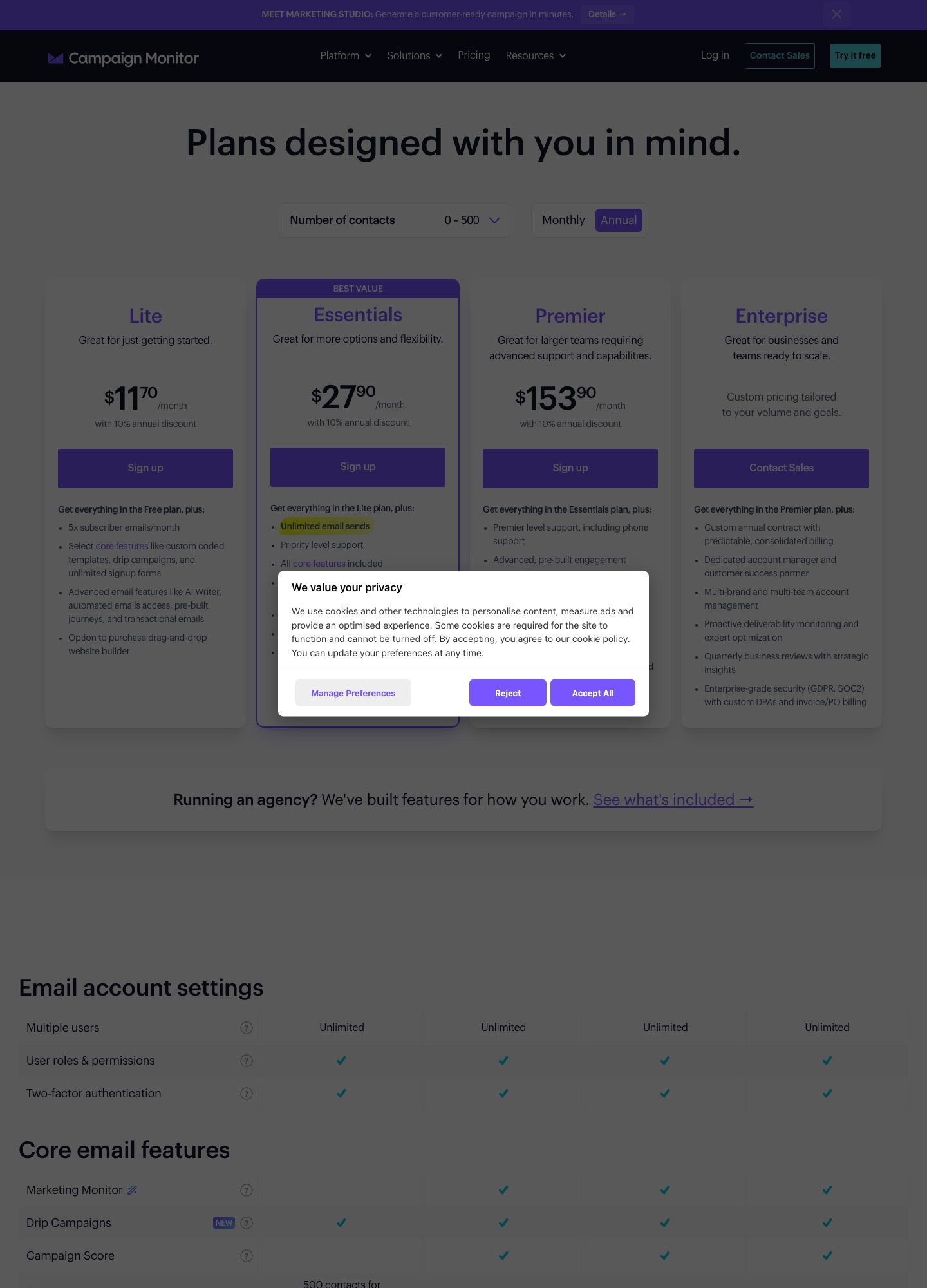
The billing unit is contacts, and the steps are steep. On the monthly toggle Lite is $13 at 500 contacts, $47 at 2,500, $75 at 5,000 and $117 at 10,000. Essentials, the plan with unlimited email sends, runs $31, $74, $117 and $182 across the same four stops. A list that grows from 2,500 to 10,000 contacts therefore raises the Essentials bill by $108 a month, $1,296 a year, even if the number of campaigns never changes.
The second trigger is what the cheap plan withholds. Lite is limited to 5 times your contacts in monthly sends, and its automated emails are described as limited to email send volume. Unlimited sends, unlimited automated emails, inbox preview and the Marketing Studio tools arrive with Essentials. Premier then jumps to $171 at 500 contacts, which is $140 above Essentials at the same list size, for phone support, send time optimization, email section locking, advanced link tracking, template management for teams and the drag-and-drop website builder. The jump narrows with list size (Premier is $182 at 2,500 contacts and $300 at 10,000), so Premier gets relatively cheaper as you grow, but small teams meet it as a wall.
The third is the trial. Campaign Monitor lists no free plan, only a 30-day free trial capped at 500 contacts and 500 emails. You cannot rehearse a real send to 5,000 people before paying. Over the limits, the pricing FAQ says you get the option to upgrade or pay for additional emails, without printing the rate. Annual billing takes 10% off (Lite at 500 contacts goes from $13 to $11.70), and nonprofits are offered 15% through sales.
What is worth keeping in mind before you move: the plan table shows "Multiple users" as unlimited on every plan, and the page lists agency features such as sub-accounts, private labeling, markup options and in-app client billing. Most alternatives below cap seats on cheaper tiers, so teams and agencies are the leavers with the most to lose. The exception is MailerLite Power, whose seats are listed as unlimited, though we did not find sub-accounts or client billing on its page.
Quick comparison
| Alternative | Best if you | Billing unit | Price at two list sizes | Free plan |
|---|---|---|---|---|
| MailerLite | want the same job for less per contact | Subscribers | Comfort $49 / $89 and Power $69 / $129 at 5,000 / 10,000 | 250 subscribers, 2,500 emails a month |
| Mailchimp | want the big template and integration ecosystem | Contact bands | Standard $100 (2,501-5,000) / $135 (5,001-10,000) | 250 contacts, 500 sends a month |
| Brevo | have a large list and send rarely | Emails per month | Starter from $9, Standard from $18 at 5,000 emails | 300 sends a day |
| Mailjet | want a low send-volume ladder | Emails per month | Essential $19 and Premium $29 at 15,000 emails | 6,000 emails a month, 200 a day |
| Constant Contact | want an established small-business vendor with seat tiers | Contacts | Lite from $12, Standard from $35, Premium from $80 | None, free trial |
| Flodesk | sell on design, not segmentation depth | Active subscribers | Lite $52 / $72 at 5,000 / 10,000 (monthly billing) | Forms and pages only, no sending |
| ActiveCampaign | need automation and CRM depth | Contacts | Starter $79 / $149 at 5,000 / 10,000 (billed annually) | None, free trial |
| HubSpot Marketing Hub | want email attached to a CRM | Seats and contact tier | Starter from $7 a month; Professional $800 a month | Free marketing tools |
The eight alternatives
1. MailerLite: the like-for-like cheaper option
MailerLite suits the small business that uses Campaign Monitor for newsletters, forms and a few automations and simply pays too much per contact. At 5,000 contacts, Comfort at $49 undercuts Lite by $26 a month and Power at $69 undercuts Essentials by $48. At 10,000, Comfort at $89 and Power at $129 sit $28 and $53 below the same two plans. Power gives unlimited monthly emails, which is the property that makes Essentials worth buying at Campaign Monitor, and Comfort allows 10 times the subscriber-tier ceiling each month, twice what Lite's 5 times allows.
You lose the polish around the edges: we did not read an inbox preview or a design and spam testing tool on MailerLite's page, and the Free plan stops at 250 subscribers with 2 user seats. Data is stored in the European Union with ISO 27001, according to its page, which some European senders will count as a gain. Migration means exporting contacts and rebuilding the templates in MailerLite's editor. The old head-to-head with Mailchimp is on MailerLite vs Mailchimp.
2. Mailchimp: more seats and a larger ecosystem, rougher price steps
Mailchimp fits a team that wants the widest template gallery and integration set and does not mind banded pricing. Its Standard plan starts at $20 for 500 contacts, then $100 for 2,501 to 5,000 contacts and $135 for 5,001 to 10,000, with a first-12-months offer of $50 and $67.50 on those two bands. Next to Campaign Monitor's Essentials at $117 for 5,000 contacts, the list prices are close at that size and Mailchimp's introductory price is under half.
The cost is control. Standard allows 5 seats, Essentials 3 and Premium unlimited users, where Campaign Monitor offers unlimited on every plan; Premium starts at $350 against Premier's $171 at the 500-contact stop. Custom-coded templates can be created on Essentials but not sent, so a team that imports HTML needs Standard or higher. Mailchimp's Free plan allows 250 contacts and 500 sends a month. The detailed pairing, including features, is on Campaign Monitor vs Mailchimp.
3. Brevo: pay for sends, not for names on a list
Brevo is the answer to a very specific pain: a 10,000-contact list that gets one campaign a month. Campaign Monitor prices that list at $117 on Lite or $182 on Essentials every month regardless of use. Brevo's pricing page says the email volume you select determines the tier, with Starter from $9 and Standard from $18 a month at 5,000 emails and a Free plan of 300 sends a day that stores up to 100,000 contacts. We read the starting prices only, so move the volume slider to your own sends before deciding.
Trade-offs: the Free plan allows automation for only 2,000 contacts, the Starter plan puts a Sent by Brevo logo in email footers unless you buy the Remove Brevo logo add-on ($10.80 a month on the pricing page, $9 in its help article), while the help article says the logo is not displayed on Standard, Professional or Enterprise. An extra marketing seat on Standard costs $9 a month. Professional starts at $499 for 150,000 to 10 million sends and 10 seats. If your agency needs unlimited users, count those seats before comparing totals.
4. Mailjet: a send-volume ladder with a small free plan
Mailjet is another volume-priced option for lists that are large relative to their sending. Mailjet's pricing page lists Free at 6,000 emails a month with a 200-emails-a-day limit and 1,000 contacts, Starter at $9 for 8,000 emails and 2,000 contacts, Essential at $19 for 15,000 emails and unlimited contacts, and Premium at $29 for 15,000 emails with no daily limit. At 50,000 emails, Essential reads $40 and Premium $59; Premium reaches $112 at 100,000 emails, $265 at 250,000 and $499 at 500,000.
For a Campaign Monitor customer with 10,000 contacts sending two campaigns a month, 20,000 emails sits between those stops, which this page does not price. The gain is that contacts are unlimited from Essential, so list growth is not the cost driver. Mailjet does list previews: Essential includes 500 email previews a month and Premium 2,000, and Premium adds team and account management. Campaign Monitor's pricing page lists design and spam testing without a monthly cap on the plan table, so heavy testers should count their previews. Subaccounts read "up to 1" on the lower Mailjet tiers, and Mailjet's custom plan lists a custom number of sub-accounts, so an agency running many client accounts would need that quote. We did not find private labeling or client billing markup on Mailjet's page.
5. Constant Contact: three seat tiers and a trial instead of a free plan
Constant Contact is for small businesses that want tiered seat counts and a plan ladder with only three rungs. Its pricing page lists Lite from $12, Standard from $35 and Premium from $80 a month, or $10.20, $29.75 and $68 billed annually, with the final price set by contact count. Lite has one user, Standard three and Premium unlimited users. Sends are capped at 10 times contacts on Lite, 12 times on Standard and 24 times on Premium, against Campaign Monitor Lite's 5 times and unlimited on Essentials.
It has no free plan, only a free trial without a card, so like Campaign Monitor it is a paid-from-day-one choice. Standard adds automation, scheduling and A/B testing; Premium adds advanced automation, segmentation, reporting and 500 SMS a month. Choose Constant Contact over Campaign Monitor only when a 3-seat Standard plan is enough and the Premium wall at $80 is more comfortable than Premier's $171. See Mailchimp vs Constant Contact for how it measures against the market leader.
6. Flodesk: for brands that sell on how the email looks
Flodesk suits the designer or boutique brand that chose Campaign Monitor for its look. Pricing is by active subscribers: Lite is $25 a month at up to 1,000 subscribers ($19 annual), $32 at 2,500, $52 at 5,000, $72 at 10,000 and $162 at 25,000. The gap against Lite is $23 a month at 5,000 contacts and $45 at 10,000. Lite includes unlimited email sends, analytics, templates and segmentation but only 1 workflow; Pro at $28 at 1,000 subscribers ($25 annual) adds unlimited workflows, advanced analytics and integrated checkout, with 2 seats, and Everything at $54 has 3 seats.
The loss is depth. Flodesk's free plan covers forms, landing pages and link-in-bio pages but does not send email or run workflows, and none of its tiers gives the unlimited users that Campaign Monitor does. Pick it for a brand with one marketer, not an agency.
7. ActiveCampaign: not cheaper, but deeper
ActiveCampaign is for the Campaign Monitor customer who has outgrown campaigns and now wants automation tied to a CRM. It is not a cost saving. Billed annually, Starter is $15 at 1,000 contacts, $39 at 2,500 contacts, $79 at 5,000 contacts and $149 at 10,000 contacts. Plus is $49 at 1,000 contacts, $95 at 2,500 contacts, $145 at 5,000 contacts and $189 at 10,000 contacts. Campaign Monitor's annual Essentials is $66.60 at 2,500 contacts, $105.30 at 5,000 contacts and $163.80 at 10,000 contacts. The Plus premium works out to $28.40, $39.70 and $25.20 a month at those three sizes.
Starter allows 1 user and 5 actions per automation, so the plan to compare with Campaign Monitor's Essentials is Plus, which still has 1 user. Pro, at $149 at 2,500 contacts and $375 at 10,000, allows 3 users and advanced segmentation. Pay that premium only if your automations branch on behavior and you will use the CRM side.
8. HubSpot Marketing Hub: email as one feature of a CRM
HubSpot is for the company that wants to send from the same system that holds its deals. HubSpot's pricing page lists Free tools, Starter at $7 a month, Professional at $800 and Enterprise at $3,600, and says Marketing Hub pricing is per seat. Its feature table gives Professional and Enterprise unlimited email-automation actions, and Professional up to 300 workflows for 10 teams.
Beside Campaign Monitor Premier at $300 for 10,000 contacts, Professional is a different category of spend, so this move only makes sense when a CRM replaces a second tool. The Starter price is a seat, not a contact bundle, and we did not read how the contact tier changes it, so a quote for your list is the honest next step.
Seats: what Campaign Monitor's unlimited users cost to replace
| Tool | Users on the entry paid plan | Users on the plan with automation | Top plan |
|---|---|---|---|
| Campaign Monitor | Unlimited | Unlimited | Unlimited |
| Mailchimp | 3 (Essentials) | 5 (Standard) | Unlimited (Premium) |
| Constant Contact | 1 (Lite) | 3 (Standard) | Unlimited (Premium) |
| Flodesk | 1 (Lite) | 2 (Pro) | 3 (Everything) |
| ActiveCampaign | 1 (Starter) | 1 (Plus), 3 (Pro) | 5 (Enterprise) |
| MailerLite | 3 (Comfort); 2 on the Free plan | Unlimited (Power) | Unlimited (Power) |
| Brevo | Extra seats $9 a month on Standard | Not read | 10 (Professional) |
Cost at three list sizes
| Tool and plan | 500 contacts | 5,000 contacts | 10,000 contacts |
|---|---|---|---|
| Campaign Monitor Lite (monthly) | $13 | $75 | $117 |
| Campaign Monitor Essentials (monthly) | $31 | $117 | $182 |
| Campaign Monitor Essentials (annual billing) | $27.90 | $105.30 | $163.80 |
| MailerLite Comfort (monthly) | $12 | $49 | $89 |
| MailerLite Power (monthly) | $25 | $69 | $129 |
| Mailchimp Standard (monthly) | $20 | $100 | $135 |
| Flodesk Lite (monthly) | $25 (to 1,000) | $52 | $72 |
| ActiveCampaign Starter (billed annually) | $15 (at 1,000) | $79 | $149 |
| ActiveCampaign Plus (billed annually) | $49 (at 1,000) | $145 | $189 |
Mailchimp's 5,000 and 10,000 figures are its 2,501-5,000 and 5,001-10,000 contact bands. Brevo, Mailjet and Constant Contact are left out because they price by email volume or by a contact count that this page did not read at these stops. Billing bases differ between rows, as labeled.
Switching from Campaign Monitor
Contacts export, with their custom fields, and that is the part everybody does first. Check that each row carries the subscribe date and source, because consent evidence is your problem and not the new vendor's. Unsubscribed, bounced and complained addresses must be imported into the destination's suppression list, not omitted. Skipping that step is how a migrated list gets mailed again by the first import.
Several things have to be rebuilt by hand. Segments are rule-based, so rewrite the rules in the new tool and compare the recipient counts against the old ones before sending. Treat drip campaigns and automated journeys as rebuilds, because they are workflows rather than data. Custom-coded HTML templates can be re-imported only where the destination supports sending them (Mailchimp's page lists custom-coded templates as create-and-send from Standard, create-only on Essentials). Transactional emails that your site sends through Campaign Monitor are a separate integration: repoint the API key and keep an eye on how transactional and marketing mail should be separated while you do it.
The 30-day trial's 500-contact and 500-email limits teach you little about a 5,000-contact send, so run the pilot on the destination, not on the source. Import one real segment of about 500 engaged contacts, send the next real campaign to it from the new tool and keep the old account sending to everybody else. If rendering, links and unsubscribes are right after two sends, move the remaining segments in two batches. The email broadcast guide covers sender authentication and warm-up for the new domain, and how to choose an email tool helps when two options tie. Browse the other incumbents on the alternatives hub, or the tools directory for vendors not listed here.
FAQ
Does Campaign Monitor have a free plan?
No. Its pricing page lists a 30-day free trial limited to 500 contacts and 500 emails, then Lite from $13, Essentials from $31 and Premier from $171 a month at the 500-contact stop. Annual billing reduces each by 10%.
What is the cheapest Campaign Monitor alternative at 10,000 contacts?
Among contact-priced tools with a published figure at that size, Flodesk Lite at $72 and MailerLite Comfort at $89 are the lowest, against $117 for Campaign Monitor Lite. Volume-priced tools such as Brevo and Mailjet can be lower still if you send rarely, but this page read only their starting prices.
I run an agency. What do I lose by leaving?
Mostly seats and client tooling. Campaign Monitor lists unlimited users on every plan plus sub-accounts, private labeling, markup options and in-app client billing. Mailchimp reaches unlimited users only on Premium, and Constant Contact only on Premium at $80 and up. MailerLite lists unlimited seats on Power, but we did not find its sub-accounts or client billing.
Is Campaign Monitor Premier worth $171?
At 500 contacts it costs $140 more than Essentials for phone support, send time optimization, email section locking, advanced link tracking, template management for teams and the website builder. Teams that need phone support or locked templates for several editors may find it fair; a solo sender usually will not.