MailerLite vs Mailchimp: what a growing newsletter list really costs
MailerLite Comfort is $49 a month at 5,000 subscribers and Mailchimp Standard is $100. Plans, send limits, yearly cost at three list sizes and how to switch.
Short answer
For a newsletter-led business whose list is heading from 5,000 toward 25,000 subscribers, MailerLite is the cheaper home over more than a year. MailerLite's pricing page lists Comfort at $49 a month for up to 5,000 subscribers, while Mailchimp's pricing page starts its Standard band for 2,501 to 5,000 contacts at $100. The first year muddies this: Mailchimp advertises 50% off for 12 months, so Standard is $50 a month at that size and the first year comes to $600 against $588 on Comfort. The gap opens from month 13. Both pages were read on 7 October 2026.
Monthly price at four list sizes
| List size | MailerLite Comfort | MailerLite Power | Mailchimp Standard | Mailchimp Standard, first 12 months |
|---|---|---|---|---|
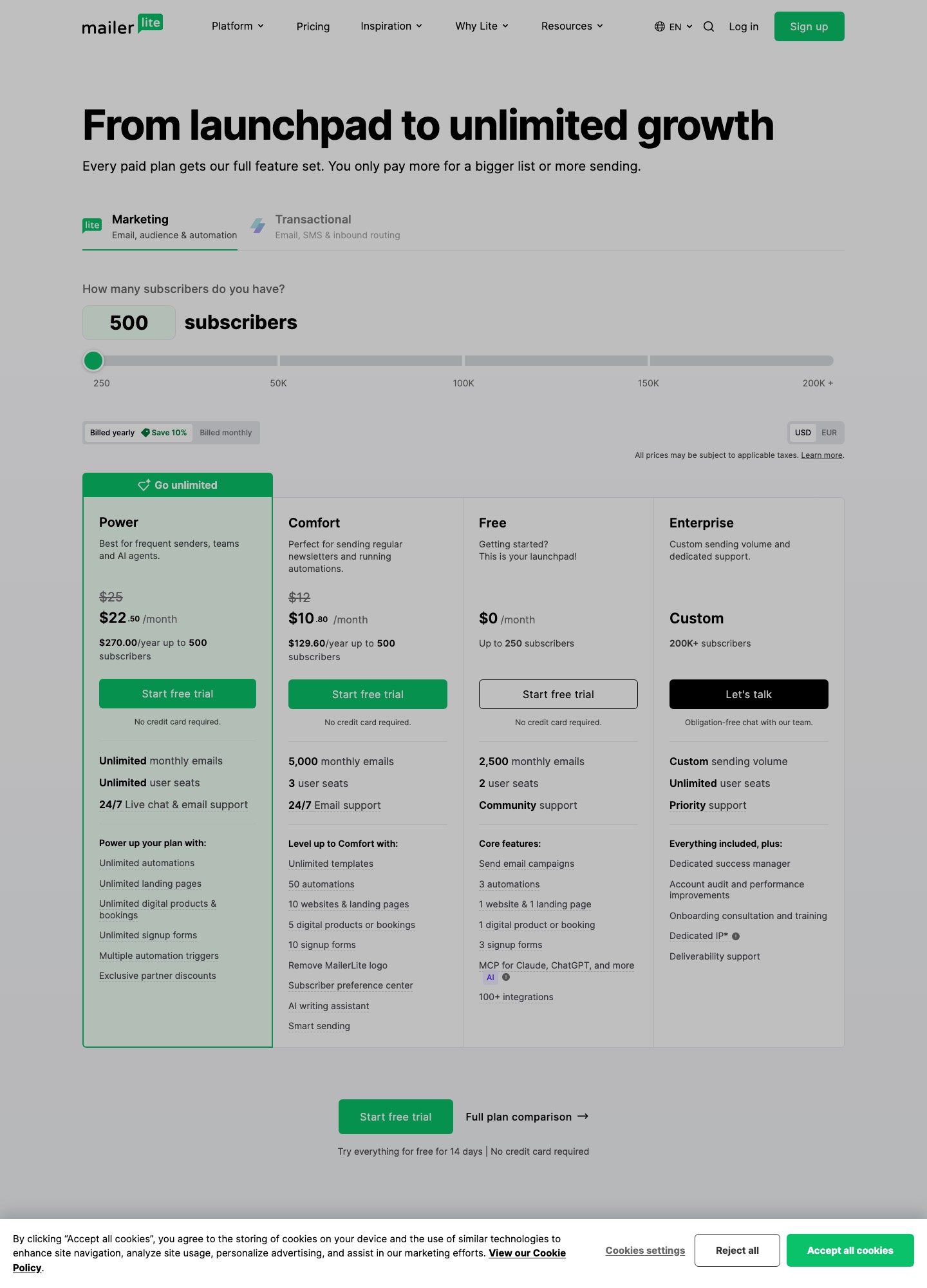
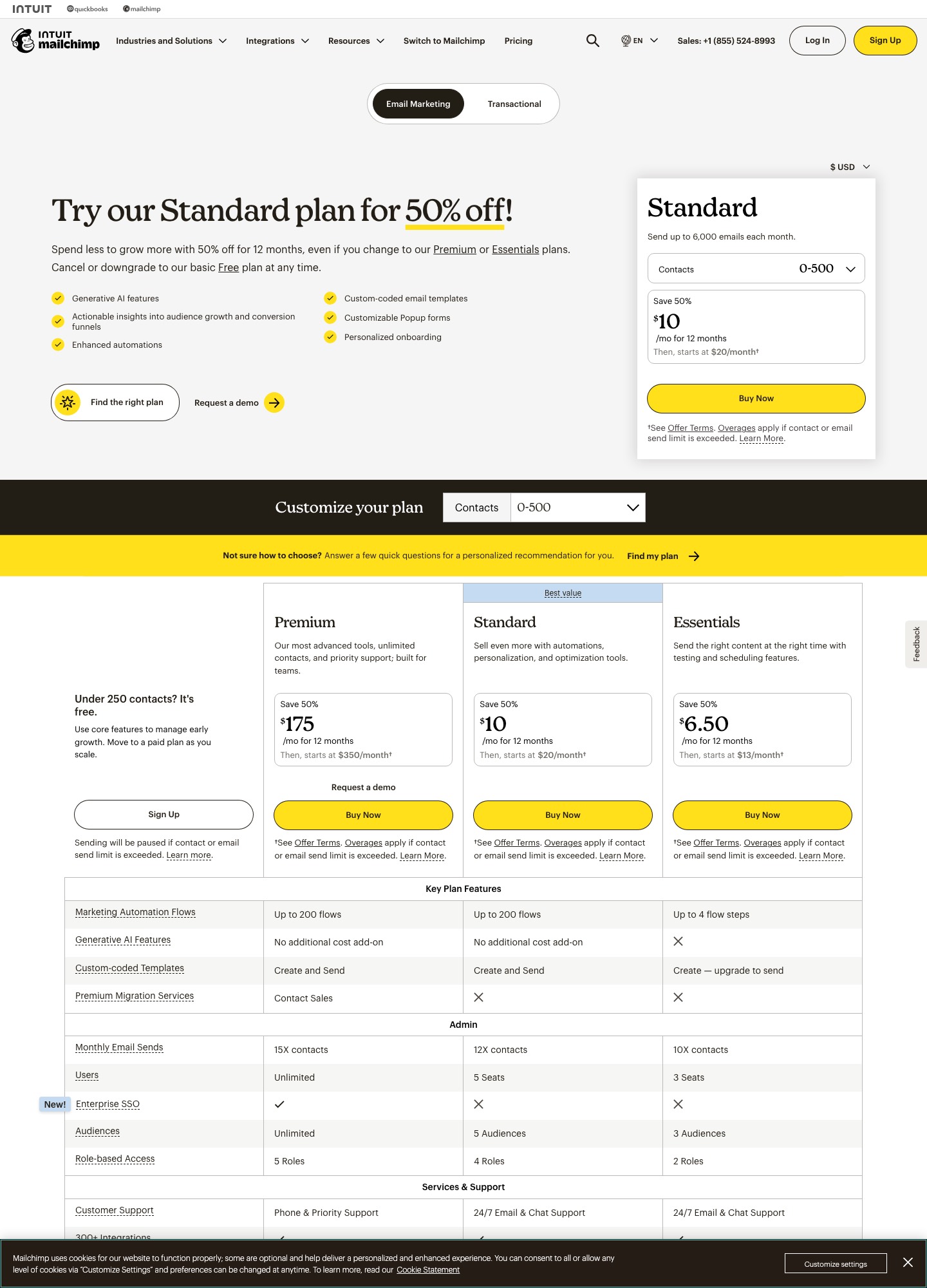
| 500 | $12 ($10.80 billed yearly) | $25 ($22.50 billed yearly) | $20 | $10 on the 50% banner |
| 5,000 | $49 | $69 | $100 | $50 |
| 10,000 | $89 | $129 | $135 (5,001 to 10,000 contacts) | $67.50 |
| 25,000 | $179 | $239 | $310 (20,001 to 25,000 contacts) | $155 |
MailerLite figures are the monthly-billing prices on the subscriber selector; its toggle says billing yearly saves 10%. Mailchimp bands contacts in ranges, so the 5,000 row means the 2,501 to 5,000 band. Mailchimp's first-12-months prices are promotional and carry offer terms on its page; the price after the offer is the list column.
What each plan includes and what it leaves out
MailerLite: Free, Comfort and Power
The Free plan covers 250 subscribers and 2,500 emails a month, with two user seats, three automations of up to five steps, one website and landing page, and three signup forms. It keeps the MailerLite logo; removing it is one of the things Comfort adds. Comfort adds unlimited templates, 50 automations, ten websites and landing pages, ten signup forms, a subscriber preference center, an AI writing assistant, smart sending and multivariate testing, with three seats. Power removes the limits on emails, seats, automations, forms and landing pages, adds multiple automation triggers, and puts 24/7 live chat and priority email support on the plan. MailerLite says every paid plan gets the full feature set and you pay more for a bigger list or more sending. Transactional email is not part of any plan; the page points to MailerSend for it.
Mailchimp: Free, Essentials, Standard and Premium
Free is one audience capped at 250 contacts and 500 sends a month, with no more than 250 in a day, and sending pauses when a limit is hit. Essentials starts at $13 for 500 contacts, with three seats and three audiences. Its automation is cut to flows of up to four steps, generative AI features are shown as unavailable, and custom-coded templates can be created but need an upgrade before you send them. Standard starts at $20, with five seats and five audiences, up to 200 flows, generative AI at no extra cost, and custom-coded templates you can create and send. Premium starts at $350, with unlimited users and audiences, enterprise single sign-on, phone and priority support, and a Contact Sales line for premium migration services.
The practical difference is the automation ceiling. MailerLite Comfort lists 50 automations and up to 100 automation steps; Mailchimp Essentials stops at four-step flows and pushes you to Standard, which means the realistic comparison for anyone running welcome series or abandoned-cart flows is Comfort or Power against Standard.
Yearly cost at three list sizes
5,000 subscribers. Comfort is 12 x $49 = $588 a year and Power is 12 x $69 = $828. Mailchimp Standard in the offer year is 12 x $50 = $600, then 12 x $100 = $1,200 in year two. Over two years that is $1,800 for Mailchimp against $1,176 for Comfort, a difference of $624.
10,000 subscribers. Comfort is 12 x $89 = $1,068 and Power is 12 x $129 = $1,548. Mailchimp Standard is 12 x $67.50 = $810 in the offer year and 12 x $135 = $1,620 afterward. Two-year totals are $2,430 for Mailchimp and $2,136 for Comfort, so the gap shrinks to $294.
25,000 subscribers. Comfort is 12 x $179 = $2,148 and Power is 12 x $239 = $2,868. Mailchimp Standard is 12 x $155 = $1,860 in year one and 12 x $310 = $3,720 in year two. Mailchimp is $288 cheaper than Comfort in year one, then $1,572 more expensive in year two, and $1,284 more across both years.
If you are likely to leave before the offer ends, or you are moving a list of 10,000 or more in order to use the introductory price, Mailchimp can win the first twelve months. For anyone staying longer, the list price is the number to budget on.
Where the send allowance bites
MailerLite sizes Comfort's monthly allowance at ten times the top of your subscriber tier: a list on the up-to-5,000 tier can send 50,000 emails a month whether it holds 3,000 or 4,900 people. Power has no cap. Mailchimp ties Standard's allowance to the contact band: its page lists 60,000 emails a month for 2,501 to 5,000 contacts and 120,000 for 5,001 to 10,000, and says overages apply when a contact or send limit is exceeded.
Take a publisher with 5,000 subscribers who sends three times a week. That is about 12 sends a month, or 60,000 emails. It is over Comfort's 50,000, so the realistic MailerLite plan is Power at $69, and it sits exactly at Mailchimp Standard's 60,000 for $100 with no spare room. A twice-weekly sender with about nine sends, 45,000 emails, fits inside Comfort with a margin.
Data location and consent paperwork
MailerLite's pricing page says its data storage center is in the European Union, holds an ISO 27001 information security certificate, and that it has GDPR controls and procedures for personal data processing. Mailchimp publishes a data processing addendum on its legal pages; the pages we read did not state a hosting region, so a buyer with an EU residency requirement should ask Mailchimp directly. Neither page replaces your own consent records: store when and where each subscriber opted in before you export anything.
Moving between the two
Mailchimp to MailerLite. Export the audience as a CSV, keep the status column, and import only subscribed contacts; carry unsubscribed and bounced addresses across as a suppression list so they are never mailed. Authenticate your sending domain in MailerLite (SPF, DKIM, and a DMARC record) before the first campaign. Rebuild automations by hand and count them: Comfort allows 50 and Free only 3. Send the first campaign to your most engaged segment, then widen it. Our Mailchimp alternatives page covers other destinations.
MailerLite to Mailchimp. Export subscribers and groups, then decide whether groups become tags or separate audiences, because Standard allows five audiences and Essentials three. Check the contact band before importing, since a list of 5,200 lands in the 5,001 to 10,000 band at $135, not $100. Free users should note the 250-contact cap before importing anything. Assume that landing pages and signup forms built in MailerLite have to be rebuilt in Mailchimp's editor. See the MailerLite alternatives page if neither fits.
Pick by situation
- Choose MailerLite Comfort if you send up to about nine newsletters a month to 5,000 or more people and need automations, landing pages and a preference center at the lowest list price.
- Choose MailerLite Power if you send more often than the ten-times allowance supports, want unlimited landing pages or digital products, or want live chat support. Power is $69 for 5,000 subscribers and $129 for 10,000.
- Choose Mailchimp Standard if you want 200 flows, five seats and generative AI on one plan, and you accept $100 to $310 a month once the first-year offer ends.
- Choose Mailchimp Free for a list under 250 contacts that sends fewer than 500 emails a month, or Premium if single sign-on and phone support are procurement requirements.
- Stay with what you have if your list is under 500: the difference there is $12 against $13 for Essentials, and migration time will cost more than the saving. The comparison hub lists other pairings worth checking.
FAQ
Is MailerLite cheaper than Mailchimp?
On list price, yes at every size we read: $49 against $100 at 5,000 contacts, $89 against $135 at 10,000, and $179 against $310 at 25,000 for Comfort against Standard. Mailchimp's 50% first-year offer reverses that for twelve months at 10,000 and 25,000 contacts.
Does MailerLite have a free plan?
Yes. Free covers 250 subscribers and 2,500 emails a month, with two seats and three automations. Mailchimp's free plan also covers 250 contacts but only 500 sends a month, 250 per day.
Does the Mailchimp 50% discount last?
Its pricing page shows it for 12 months, followed by the list price, and links to offer terms that apply. Put the post-offer figure in your budget: $100, $135 or $310 a month at the three sizes above.
Can either one send transactional email?
MailerLite sends campaigns and automations only and points to MailerSend, a separate product, for transactional mail. Mailchimp shows a Transactional tab beside Email Marketing on its pricing page.