SendGrid vs Mailgun: which email API costs less at your volume?
SendGrid Email API starts at $19.95, Mailgun at $15 for 10,000 emails. Compare cost from 10k to 150k emails a month, dedicated IPs, logs and EU hosting.
Short answer
Mailgun is cheaper at small volume and SendGrid is cheaper in the middle. Mailgun's pricing page lists Basic at $15 a month for 10,000 emails, Foundation at $35 for 50,000 and Scale at $90 for 100,000. SendGrid's Email API page lists Essentials from $19.95 for the 50,000 to 100,000 range and Pro from $89.95 for 100,000 to 2.5 million. At 100,000 emails the two are within five cents of each other, so the choice there rests on features: Pro includes a dedicated IP, and Mailgun's Scale offers dedicated IP pools plus phone and chat support. SendGrid also sells a separate product for newsletters, Marketing Campaigns, and Mailgun's sending plans have no counterpart to it.
Prices checked 7 October 2026, in US dollars. Both are starting prices that move with the volume you pick in each vendor's selector, and SendGrid adds that taxes and overages may apply.

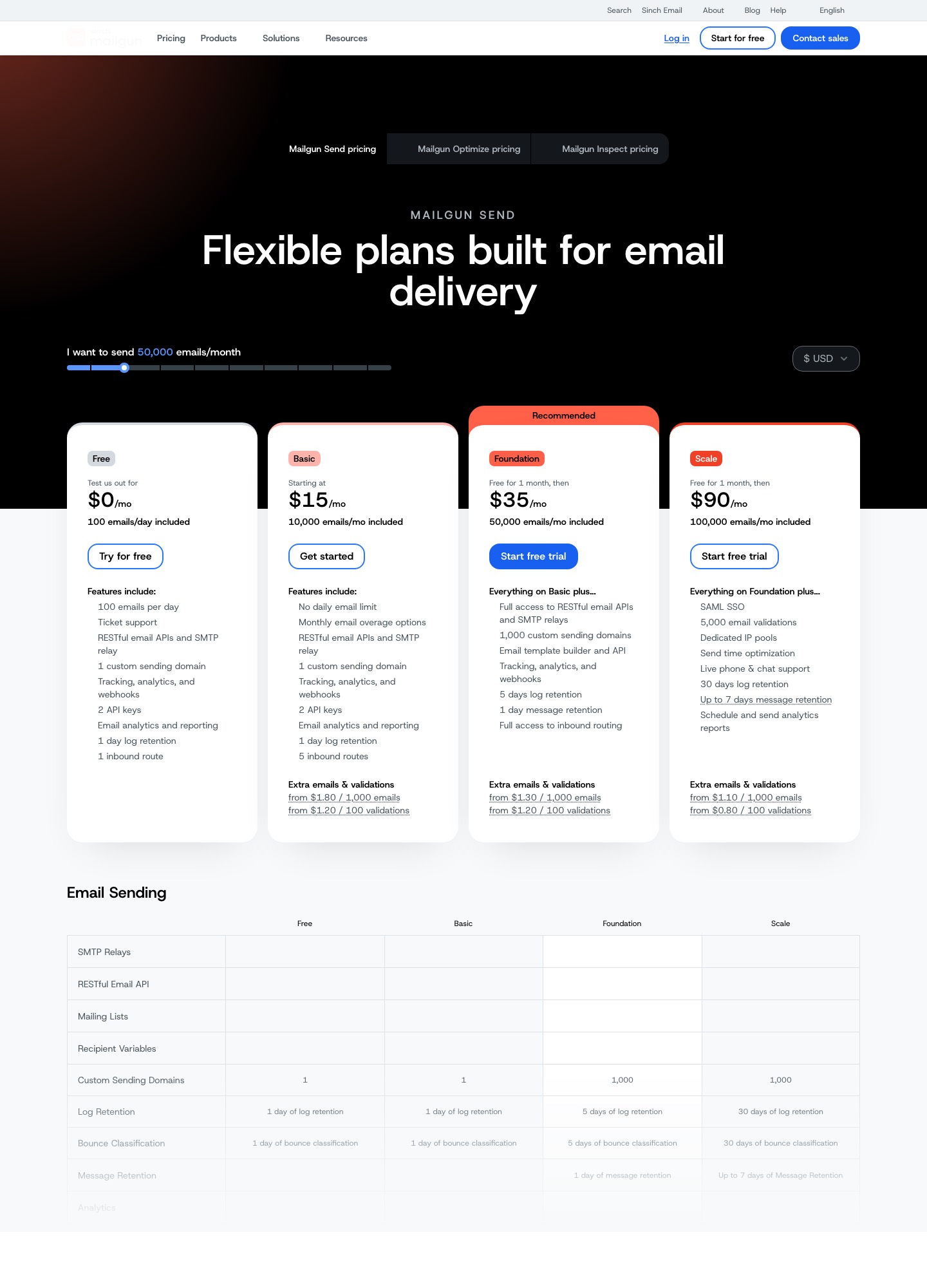
The plans next to each other
| SendGrid Email API | Mailgun (Send) | |
|---|---|---|
| Free | Trial: 100 emails a day for 60 days, no card | Free plan: 100 emails a day, 1 custom sending domain, 1 day of logs |
| Entry paid plan | Essentials from $19.95 a month; selector range 50,000 to 100,000 emails | Basic from $15 a month with 10,000 emails and no daily limit |
| Middle plan | Pro from $89.95; 100,000 to 2,500,000 emails | Foundation $35 for 50,000 emails, free for the first month |
| Top self-serve plan | Premier, custom pricing | Scale $90 for 100,000 emails, free for the first month |
| Extra emails | Overages may apply; the page links to an overage article that gives no per-email rate | From $1.80, $1.30 and $1.10 per 1,000 on Basic, Foundation and Scale |
| Dedicated IP | One included on Pro and Premier | Included from Scale; extra IPs $59 per IP per month |
| Users | 1 teammate on Essentials, 1,000 on Pro | 1 user on Free; the FAQ says every plan except Free and Basic allows unlimited users |
| Activity or log history | 3 days on Essentials, 7 on Pro; more can be bought | 1 day on Free and Basic, 5 on Foundation, 30 on Scale |
Sources: the two pricing pages linked above. Mailgun's page has separate tabs for Optimize and Inspect; this comparison covers Send only, which is the sending plan. SendGrid's marketing product is covered below.
What each volume costs
The table below puts the same monthly volume against each vendor's published starting prices. Where a plan would have to be stretched past its included volume, the extra emails use the lowest rate shown on the page ("from"), so those cells are a floor, not a quote.
| Emails a month | SendGrid Email API | Mailgun | Cheaper |
|---|---|---|---|
| 3,000 | Free trial for 60 days, then Essentials from $19.95 | Free plan if you stay under 100 a day (about 3,000 a month), else Basic $15 | Mailgun |
| 10,000 | Essentials from $19.95 | Basic $15 | Mailgun, by $4.95 a month ($59.40 a year) |
| 50,000 | Essentials from $19.95 | Foundation $35 | SendGrid, by $15.05 a month ($180.60 a year) |
| 100,000 | Pro from $89.95 | Scale $90 | A tie: $0.05 apart |
| 150,000 | Pro from $89.95; read the selector for the exact figure | Scale $90 plus 50 × $1.10 = $55, so at least $145 | SendGrid, if its selector stays near its starting price |
Three details sit behind those rows. First, the 3,000 emails a month on Mailgun's free plan is only reachable if you spread them out: 100 emails a day is a hard daily ceiling, so a day with 300 password resets stops sending. Second, at 50,000 emails Mailgun's Foundation price is $35 against SendGrid's entry $19.95, but SendGrid's page does not break out the exact Essentials price at 50,000 as opposed to 100,000, so $19.95 is the best case. Third, Mailgun's overage rate has an arithmetic of its own: staying on Foundation for 100,000 emails would cost $35 plus 50 × $1.30 = $65 extra, a floor of $100, which is more than Scale's $90, so the page's own numbers say to move up at that volume.
Dedicated IPs and sender reputation
A shared IP pool is fine until a neighbour on it misbehaves. SendGrid includes one dedicated IP on Pro, from $89.95, and lists automated dedicated-IP warm-up and IP pooling in its deliverability table. Mailgun's FAQ says one dedicated IP is included with Foundation at 100,000 emails, Growth and Scale, its feature table says access starts at 50,000, and extra IPs cost $59 per IP per month. Scale at $90 also lists dedicated IP pools. In practice the two vendors put a dedicated IP at almost the same monthly price, around $90, so the question is whether you need one at all. At modest volume a shared pool may be all you need, and Mailgun's own FAQ says some customers are happy on shared IPs while others prefer the control a dedicated one gives over reputation.
Logs, webhooks and debugging windows
The retention windows matter the first time a customer says a receipt never arrived. SendGrid's searchable email activity covers 3 days on Essentials and 7 on Pro, with up to 30 days available for purchase. Mailgun keeps logs for 1 day on Free and Basic, 5 on Foundation and 30 on Scale, and message content for 1 day on Foundation and up to 7 on Scale. If your support team investigates complaints a week later, the cheapest plan of either vendor will not remember the message; Scale, or the SendGrid add-on, will.
On events, SendGrid counts event webhooks per plan (1 on the trial, 2 on Essentials, 5 on Pro) and says webhook requests can be signed or secured with OAuth 2.0. Mailgun lists tracking, analytics and webhooks on every plan, without a count we could read. SendGrid's Pro plan also includes 2,500 email validations, and Mailgun's Scale includes 5,000; the cheaper Mailgun plans sell validations at from $1.20 per 100.
Where your data lives
Mailgun's pricing page says a single account can send through the US or the EU and that its service is hosted in both regions. SendGrid's privacy table lists GDPR compliance and an EU data-residency item, described as covering email events from sending and tracking, "primarily processed within Europe"; the page does not say which plans include it, so ask before you rely on it. Neither page replaces a data-processing review.
The same message through each API
Both services accept a plain HTTP call, which is the part that moves with you if you ever switch. These are the examples from each vendor's own documentation, with its placeholders: Mailgun's quickstart and SendGrid's API getting-started guide.
Mailgun authenticates with HTTP basic auth (the user name is api) and takes form fields. The quickstart sends from its sandbox domain, and the recipient must be authorised first.
curl --user 'api:YOUR_API_KEY' \
  https://api.mailgun.net/v3/YOUR_SANDBOX_DOMAIN/messages \
  -F from='Test <postmaster@YOUR_SANDBOX_DOMAIN>' \
  -F to='your-email@example.com' \
  -F subject='Hello!' \
  -F text='Test message'
SendGrid takes JSON with a Bearer key at /v3/mail/send; the guide notes that Basic authentication is no longer accepted.
curl --request POST \
  --url https://api.sendgrid.com/v3/mail/send \
  --header 'Authorization: Bearer <<YOUR_API_KEY>>' \
  --header 'Content-Type: application/json' \
  --data '{"personalizations":[{"to":[{"email":"john.doe@example.com","name":"John Doe"}],"subject":"Hello, World!"}],"content": [{"type": "text/plain", "value": "Heya!"}],"from":{"email":"sam.smith@example.com","name":"Sam Smith"},"reply_to":{"email":"sam.smith@example.com","name":"Sam Smith"}}'
Mailgun's FAQ recommends the HTTP API over SMTP for applications and says the API is more reliable at scale. It also says there is no send button in Mailgun, which is a polite way of saying it has no campaign editor.
Newsletters are a different product
If your job is a newsletter rather than receipts, neither Email API nor Mailgun Send is where you start. SendGrid's separate Marketing Campaigns product has a free plan for up to 2,000 contacts and 6,000 emails a month, then Basic from $15 and Advanced from $60, with editors, segmentation and automation. The two SendGrid products are billed and counted separately, so a team that wants both holds two plans. Our Brevo vs SendGrid comparison goes through that split, and for newsletter-only senders the newsletter tools page is a better starting point.
Moving between them
- Create the sending domain in the new service and publish its SPF and DKIM records before any real mail. Google requires at least one of the two from all senders, per its sender guidelines.
- Export suppression lists (bounces, unsubscribes and spam complaints) from the old vendor and import them into the new one.
- Swap the API call: a form post with basic auth becomes a JSON post with a Bearer key, or the reverse.
- Repoint event webhooks and handle the new event names; keep the old endpoint alive for a week to catch late events.
- Send a small share of traffic first, watch bounces and complaints, then move the rest.
Choose SendGrid if
- you send between 50,000 and 100,000 emails a month and want the lowest entry price, from $19.95;
- you want a dedicated IP with automated warm-up on a plan that starts at $89.95;
- you also need a newsletter product with a free tier, or already build on Twilio;
- you want many teammates: Pro lists 1,000.
Choose Mailgun if
- you send around 10,000 emails a month and want to pay $15 instead of $19.95;
- you need to choose between US and EU sending from one account;
- you want 30 days of logs, phone and chat support, SAML SSO and 5,000 validations in a single $90 plan;
- you run many sending domains: Foundation and Scale list 1,000 custom sending domains.
If a developer-first transactional service is the goal, Postmark vs SendGrid sets SendGrid against a narrower rival, and the SendGrid alternatives and Mailgun alternatives pages widen the field. For very large senders, start from high-volume sending.
FAQ
Is SendGrid cheaper than Mailgun?
It depends on volume. Mailgun Basic is $15 for 10,000 emails, below SendGrid Essentials at $19.95. At 50,000, SendGrid's $19.95 starting price is lower than Mailgun Foundation at $35. At 100,000, SendGrid Pro from $89.95 and Mailgun Scale at $90 are essentially level.
Does either have a permanent free plan?
Mailgun does: 100 emails a day with one custom sending domain. SendGrid's Email API offers a free trial of 100 emails a day for 60 days, though its Marketing Campaigns product has a permanent free plan for 2,000 contacts and 6,000 emails a month.
Which includes a dedicated IP?
SendGrid includes one on Pro and Premier. Mailgun includes one with Foundation at 100,000 emails and on Scale, and sells extra IPs at $59 per IP per month.
Can Mailgun send newsletters?
Mailgun is an email delivery API with mailing lists, templates and webhooks, but its own FAQ says it has no send button. For a campaign editor with segmentation, use a marketing tool, or SendGrid's separate Marketing Campaigns product.