Postmark vs SendGrid: which one should send your transactional email?
Postmark Basic is $55 at 50,000 emails and SendGrid Essentials $19.95, but at 300,000 the order flips ($245 vs $249). Streams, webhooks, IPs and limits.
Short answer
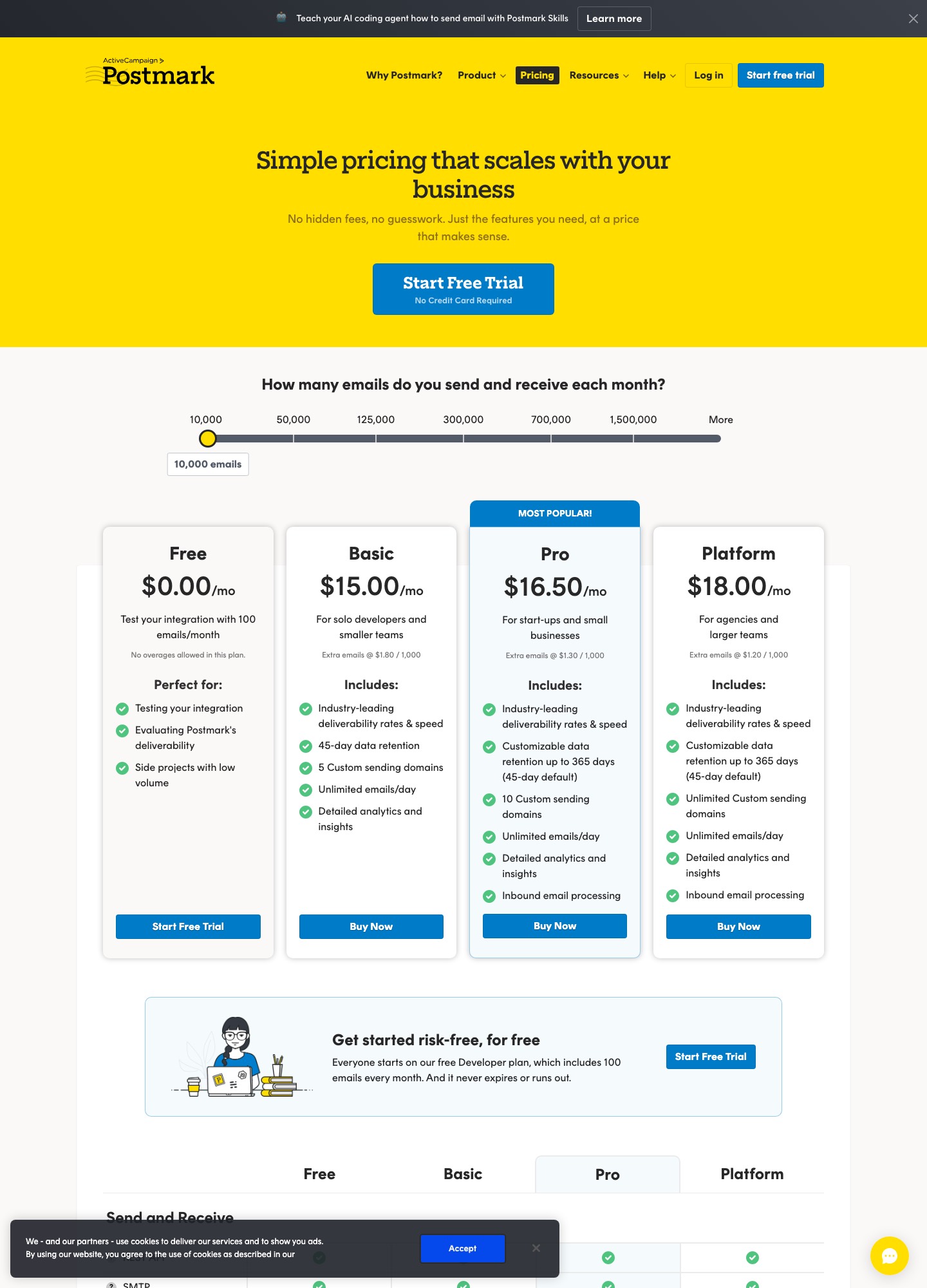
SendGrid is the cheaper way to send 50,000 emails a month: Essentials is $19.95 on SendGrid's Email API pricing page, against $55 for Postmark Basic on Postmark's pricing page. The gap closes as volume grows, and at 300,000 emails Postmark Basic ($245) is a few dollars under SendGrid Pro ($249). Postmark keeps transactional mail and broadcasts in separate streams inside one account, while SendGrid sells its Email API and its Marketing Campaigns as two separate products. Both were read on 7 October 2026. Everything below is about the Email API side of SendGrid unless it says otherwise.
Price at five volumes
| Emails per month | Postmark Basic / Pro / Platform | SendGrid Email API | What the numbers say |
|---|---|---|---|
| 10,000 | $15 / $16.50 / $18 | Entry plan Essentials, $19.95 (selector starts at 50,000) | Postmark Basic is $4.95 cheaper, SendGrid includes more headroom |
| 50,000 | $55 / $60.50 / $66 | Essentials $19.95 | SendGrid is $35.05 cheaper than Basic |
| 100,000 | Not a slider stop (next stop is 125,000) | Essentials $34.95, or Pro $89.95 | No like-for-like read |
| 125,000 | $115 / $126.50 / $138 | Pro, between its 100,000 ($89.95) and 300,000 ($249) stops | Pro at 125,000 not read |
| 300,000 | $245 / $269.50 / $294 | Pro $249 | Postmark Basic is $4 cheaper than Pro |
All figures are positions on each vendor's volume selector, read on 7 October 2026. Postmark's slider stops at 10,000, 50,000, 125,000 and 300,000 (and higher); SendGrid's Email API selector offers Essentials for 50,000 to 100,000 emails and Pro for 100,000 to 2,500,000, with Pro read at $89.95 (100,000), $249 (300,000), $499 (700,000), $799 (1,500,000) and $1,099 (2,500,000). SendGrid lists taxes and overages as possible extras on both paid plans.

Three worked examples
A product that sends 10,000 emails a month. Postmark Basic is $15, or $180 a year. SendGrid's cheapest paid Email API plan is Essentials at $19.95, $239.40 a year, and it covers 50,000 to 100,000 emails. You pay $59.40 more across the year for five times the headroom, and the free alternatives are very different: SendGrid's trial allows 100 emails a day for 60 days, at most 6,000 emails in total, while Postmark's free plan allows 100 emails a month with no expiry and no overage.
A store that sends 50,000 order and shipping emails. SendGrid Essentials costs $19.95 a month, $239.40 a year. Postmark Basic costs $55, or $660 a year, so the difference is $420.60. Postmark Pro at $60.50 and Platform at $66 widen the gap to $486.60 and $552.60 a year. What the extra money buys at Postmark is the stream separation, a longer log history and, on Pro and Platform, inbound email processing, covered below.
A platform that sends 300,000 emails. SendGrid Pro is $249 and includes one dedicated IP, single sign-on and up to 1,000 teammates according to its pricing page. Postmark Basic is $245, Pro $269.50 and Platform $294. The two lists stop being separated by tens of dollars and start being separated by what each plan includes. Postmark sells a dedicated IP from $50 a month per IP, but only to customers sending 300,000 emails a month or more on Pro or higher, so a Pro plan with an IP is $269.50 plus $50 at this size, $319.50 a month.
SendGrid is two products, Postmark is one account with streams
SendGrid's Marketing Campaigns is priced apart from the Email API: a free plan for 2,000 contacts and 6,000 emails a month, then Basic from $15 and Advanced from $60. Mixing those with the Email API prices above is the most common way to misread SendGrid, so this page keeps them separate and only the Email API is compared. Postmark handles the same split inside one account. Its message streams page describes a transactional stream and a broadcast stream that never share IP ranges, and says broadcasts need an unsubscribe link while transactional mail does not. All streams draw on one monthly allowance, so the separation protects reputation without splitting your bill. Why that separation matters is explained in our note on transactional versus marketing mail.
Webhooks and how you protect them
Postmark's webhook overview offers no HMAC signature. It names two protections: Basic Auth credentials in the webhook URL and an allowlist of the IP ranges Postmark sends from. It checks for a 200 response when you add an endpoint, retries failed calls six times at 1, 5, 10, 10, 10 and 15 minutes, and retries only on 5xx, 408, 429 and connection errors, so another 4xx response is dropped for good. If your own service has a temporary fault, return a 5xx, never a 400 or 404. The docs advise storing the MessageID or the X-PM-Webhook-Trace-Id header so a repeated delivery is not processed twice.
SendGrid's pricing page lists Event Webhook Security as signed requests or OAuth 2.0 authorization, which suits teams that want a signature rather than an IP list. The number of event webhooks is tied to the plan: 1 on the trial, 2 on Essentials and 5 on Pro. We did not read SendGrid's webhook documentation, so check the signing details there before you build against it. On the inbound side, SendGrid lists an Inbound Parse Webhook for incoming mail and Postmark lists inbound email processing on Pro and Platform but not on Basic.
Logs, retention and support questions
Debugging an undelivered email usually starts with the activity log. SendGrid's page lists searchable email activity of 3 days on the trial and Essentials and 7 days on Pro, with up to 30 days of history available to buy. Postmark keeps data for 45 days by default and lets Pro and Platform customers stretch that to 365 days; a custom activity retention add-on starts at $5 a month. If your support team handles "I never got the receipt" tickets a few weeks after the fact, 3 or 7 days will not cover them and 45 days will.
Dedicated IPs and the rest of the toolbox
SendGrid's Pro and Premier plans include one dedicated IP, with IP pooling and automated warm-up listed alongside, plus domain authentication with SPF and custom DKIM, link branding, reverse DNS, suppression management and a Deliverability Insights dashboard. The page also lists SOC 2 Type II, GDPR compliance and EU data residency for email events. Postmark's pricing page shows DMARC monitoring from $14 a month per domain as an add-on. We did not read Postmark's equivalent compliance statements, so verify them if you have a regulatory requirement. For more on how SendGrid compares with an all-in-one platform, read Brevo vs SendGrid; against another API-first rival, SendGrid vs Mailgun and Resend vs Postmark cover the neighbouring choices.
Choose Postmark if…
- transactional mail and broadcasts must live in one account but never share an IP range;
- your volume sits near 10,000 a month, where Basic at $15 is under SendGrid's $19.95 entry price;
- support has to look back more than a week: 45 days by default and up to 365 days on Pro and Platform;
- you run at 300,000 emails or more and want Basic's $245 against SendGrid Pro's $249.
Choose SendGrid if…
- you send 50,000 to 100,000 emails a month and want to pay $19.95 to $34.95 rather than $55 and up;
- you want a signed or OAuth-secured event webhook instead of Basic Auth with an IP list;
- you need many teammates (1,000 on Pro) or single sign-on on the same plan as a dedicated IP;
- you already buy other Twilio products and want one vendor.
Moving from one to the other
From SendGrid to Postmark, authenticate your sending domain in Postmark first, export your suppression list so bounced and unsubscribed addresses are not mailed again, and decide which messages go to the transactional stream and which to broadcasts. Replace the signed-webhook check with Basic Auth in the URL and the IP allowlist, and rebuild SendGrid dynamic templates in Postmark by hand. Moving the other way, create a webhook that verifies SendGrid's signature, map Postmark's streams onto Email API and, if you used broadcasts, a separate Marketing Campaigns plan, and keep both providers live until a password reset, a receipt and a bounce notification have all passed through the new one. Browse the rest of the comparison hub or our transactional email guide for more shortlists.
FAQ
Is Postmark more expensive than SendGrid?
At 50,000 emails a month, yes: Basic is $55 against SendGrid Essentials at $19.95. At 300,000 the order reverses, with Postmark Basic at $245 and SendGrid Pro at $249. Near 10,000 emails, Postmark Basic at $15 is under SendGrid's $19.95 entry price.
Does SendGrid have a free plan for transactional email?
Its Email API offers a free trial of 100 emails a day for 60 days. Marketing Campaigns has a separate free plan with 2,000 contacts and 6,000 emails a month. Postmark's free plan allows 100 emails a month without expiry.
Does Postmark sign its webhooks?
No HMAC signature is offered. Its documentation recommends Basic Auth credentials in the webhook URL together with an allowlist of Postmark's IP ranges, and a stored message ID to deduplicate retries.
Which one includes a dedicated IP?
SendGrid Pro and Premier include one. Postmark sells dedicated IPs from $50 a month each, for customers sending 300,000 emails a month or more on Pro or higher.