Mailgun alternatives for API email sending: nine options priced from 10,000 to 250,000 emails
Nine Mailgun alternatives priced at 10,000 to 250,000 emails a month: Amazon SES is $16 at 100,000 against Mailgun Scale at $90. Logs, IPs and limits compared.
Short answer
Amazon SES is the pick if all you need is sending and you can run it yourself: SES's Essentials rate is $0.16 per 1,000 emails, so 100,000 emails a month come to $16, against $75 on Mailgun Foundation (its slider reading) or $90 on Scale. If you are leaving because Mailgun's Basic plan keeps logs for one day and you cannot debug yesterday's bounce, choose Postmark: its default activity history is 45 days and Basic is $15 at 10,000 emails, the same entry price as Mailgun.
Why teams leave Mailgun
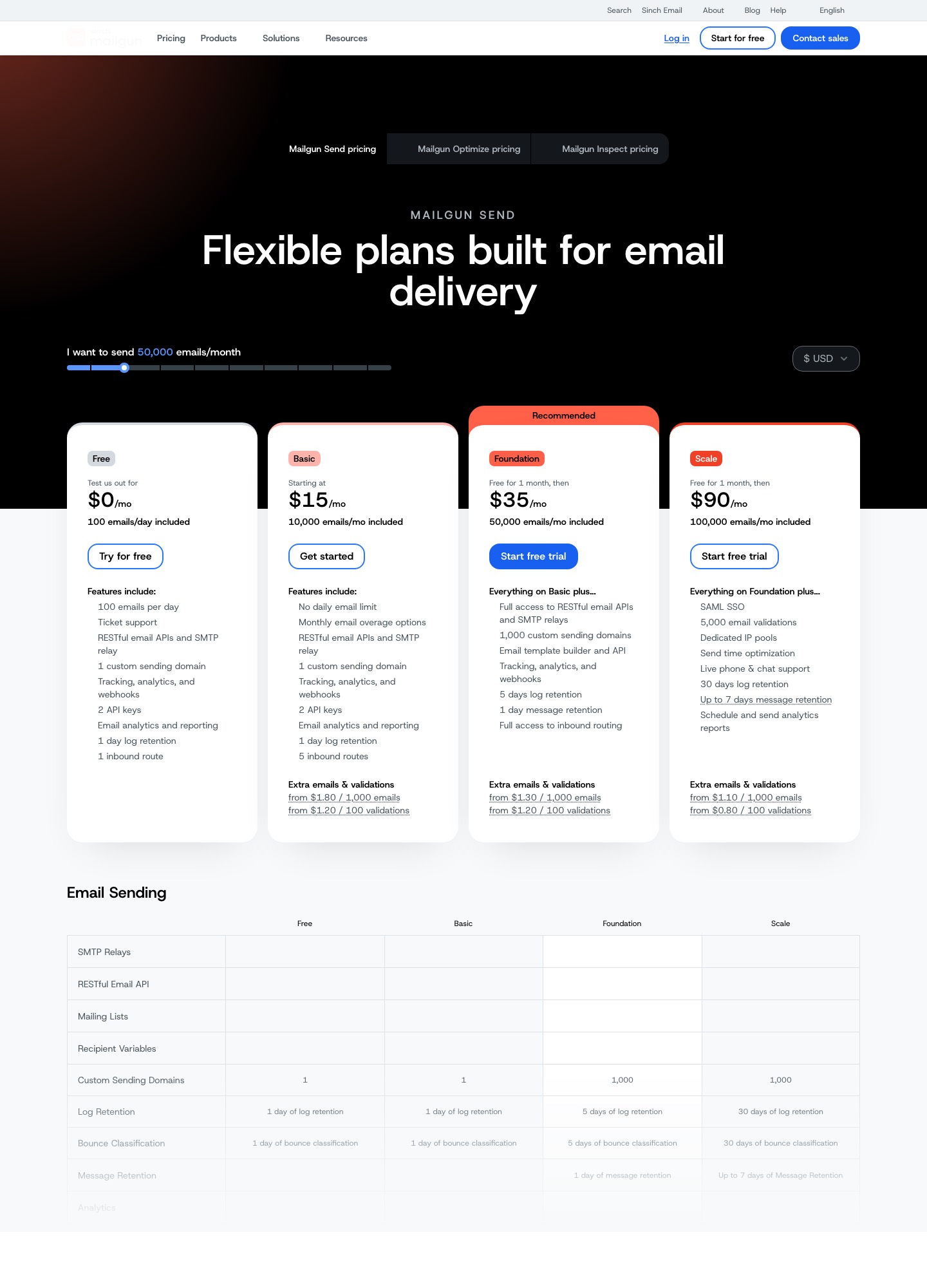
Mailgun sells monthly email-volume plans with usage-based overages. Its pricing page lists Basic at $15 for 10,000 emails, Foundation at $35 for 50,000 and Scale at $90 for 100,000, with extra emails from $1.80, $1.30 and $1.10 per 1,000 respectively. The free plan is 100 emails a day, one custom sending domain and one day of logs. Foundation and Scale each start with a free month.
Four details drive the decision to leave. The first is log retention: 1 day on Basic, 5 on Foundation, 30 on Scale. A bounce that surfaces on Monday morning for a Friday send is gone on Basic. The second is the jump at 100,000 emails: the Foundation slider reads $75 there, Scale reads $90, and the extra $15 buys 30-day retention and 5,000 included validations. The third is dedicated IPs. One is included with Foundation at 100,000 emails, Growth and Scale, and each additional IP is $59 a month. The fourth is that validation overage runs from $1.20 per 100 on Basic and Foundation and $0.80 per 100 on Scale, so a verification-heavy workflow adds a bill of its own.
Above 100,000 the slider reads $215 for Scale at 250,000 emails and $400 at 500,000. Those are the volumes where per-email infrastructure services pull ahead, as the cost table near the end shows.
Quick comparison
| Tool | Switch if you | Price at 50,000 and 100,000 | Free plan | Dedicated IP |
|---|---|---|---|---|
| Mailgun (baseline) | Stay for inbound routing | Foundation $35; Scale $90 (Foundation $75) | 100 emails a day | $59 per extra IP |
| Amazon SES | Want the lowest price | $8 and $16 at $0.16 per 1,000 | 6-month plan, up to $200 credits (new AWS accounts) | $24.95 a month each |
| Postmark | Need logs you can search | Basic $55 at 50,000; 125,000 is $115 | 100 emails a month | From $50 a month |
| SparkPost | Need 30-day retention cheaply | Startup $15 and $30 | 1,000 a month, 50 a day | $24.95 each, Growth only |
| Mailtrap | Want a flat plan ladder | Basic $20 and $30 | 4,000 a month, 150 a day | Not on the pricing readout |
| Resend | Want a developer-first setup | Pro $20 and $35 | 3,000 a month, 100 a day | $30 a month, Scale only |
| SendGrid | Want a big-vendor option | Essentials $19.95 and $34.95 | 100 a day for 60 days | Included in Pro |
| MailerSend | Want a small-team plan | Starter $31.50 (50,000); $68 at 100,000 | 500 a month | Not on the pricing readout |
| SMTP2GO | Send under 10,000 | Starter $10 (10,000); Professional $75 (100,000) | 1,000 a month, 200 a day | Not on the pricing readout |
| Elastic Email | Need inbound and webhooks | Starter $19 and Pro $49 at 50,000 | 3,000 a month, 100 a day | Not on the pricing readout |
Figures are read from each vendor's pricing page on 7 October 2026. Where the table says "not on the pricing readout", the source this page uses does not state dedicated-IP terms, so ask the vendor before assuming. Postmark and SparkPost publish volume stops that do not match 50,000 or 100,000 exactly, and the cells say which stops exist.
1. Amazon SES: $16 for 100,000 emails
SES is billed per email: Essentials is $0.16 per 1,000 for the first 10 million emails a month. That makes 50,000 emails $8, 100,000 emails $16 and 250,000 emails $40 (250,000 x $0.16 per 1,000, the example on its own pricing page). Against Mailgun that is $59 a month below Foundation's $75 at 100,000 ($708 a year) and $74 below Scale's $90 ($888 a year). At 250,000, SES at $40 sits $175 below Scale's $215. At 500,000 it is $80 against $400.
Higher plans add a fixed fee: Pro is $0.22 per 1,000 plus $105 per account per region per month, and Enterprise is $0.23 plus $500. Eligible new AWS customers get a free plan for six months with up to $200 in credits. A standard dedicated IP costs $24.95 a month, compared with Mailgun's $59 for an extra one. The trade is that SES is infrastructure, not a product. This page does not list its log-retention window, and you assemble the dashboards, alerting and suppression handling around it; its feature list names SMTP and API sending, deliverability monitoring and Mail Manager inbound processing, which is the part to compare with Mailgun's inbound routes.
2. Postmark: 45 days of history for the same $15
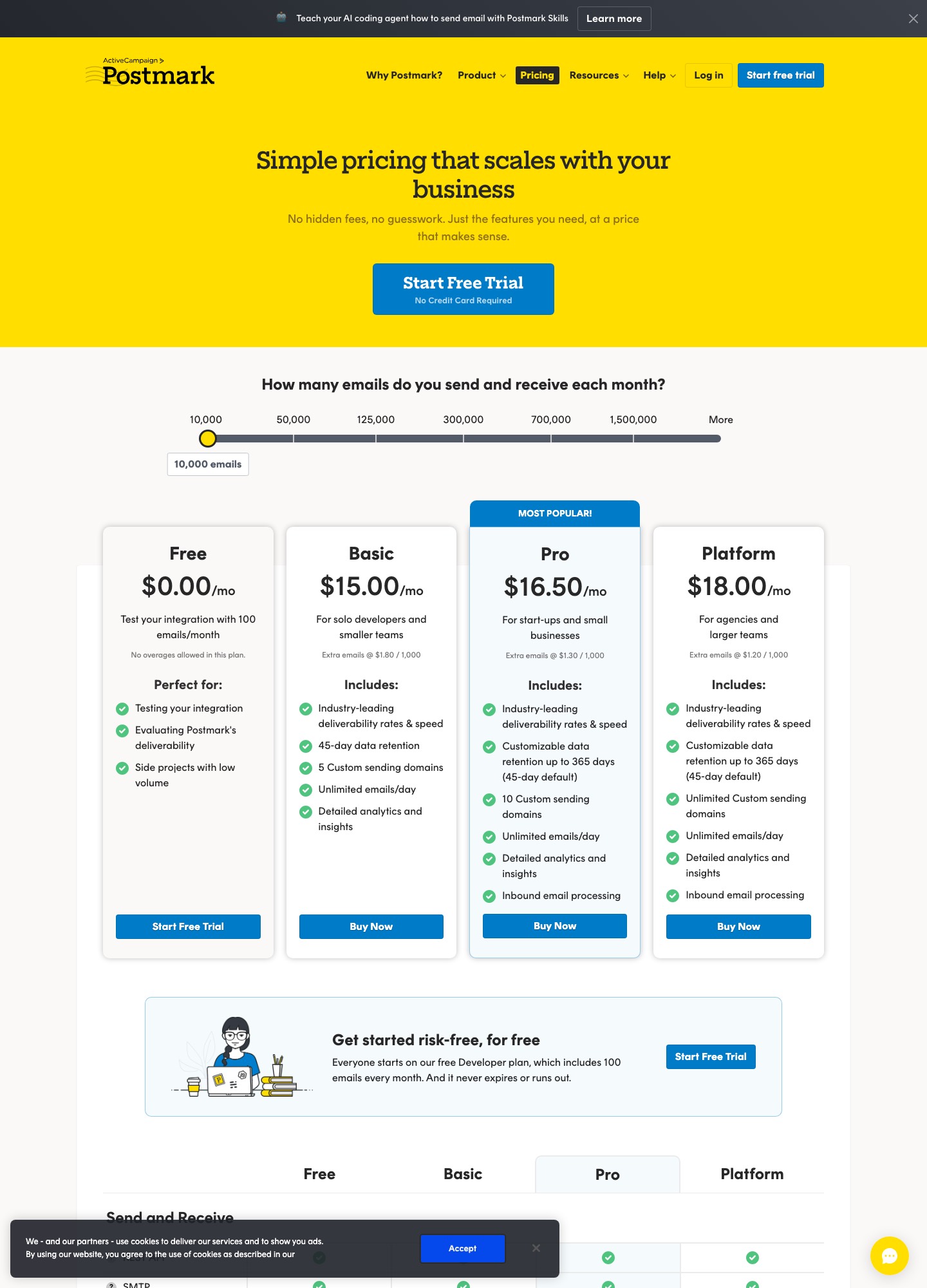
Postmark answers the one-day log window directly. Basic is $15 for 10,000 emails, identical to Mailgun Basic, but it carries 45 days of data retention where Mailgun Basic carries one. The pricing page also lists customizable retention up to 365 days, and a custom activity retention add-on starting at $5 a month. Slider stops are 10,000, 50,000, 125,000 and 300,000: Basic is $15, $55, $115 and $245, Pro $16.50, $60.50, $126.50 and $269.50, Platform $18, $66, $138 and $294.
Its weakness against Mailgun is price in the middle. At 50,000 emails Basic is $55 against Foundation's $35, and 100,000 is not a stop at all. Dedicated IPs start at $50 a month and are for customers sending 300,000 emails or more on Pro or above, so a team that relied on Foundation's included IP loses it. Inbound email processing is on Postmark's feature list. It is a good swap at or below 50,000 emails when support tickets matter more than cents. See Resend vs Postmark and Postmark vs SendGrid.
3. SparkPost: 30 days of retention at $15
SparkPost's pricing page states a 30-day retention and a 20 MB message-size limit on every plan, so the retention Mailgun reserves for Scale ($90) comes with a $15 Startup plan covering 50K emails. Startup reads $30 at 100K, against Mailgun Foundation's $75 at the same volume (a $45 gap). Growth is $80 at 100K, $175 at 250K, $295 at 500K and $530 at 1M, and adds dedicated IPs at $24.95 a month each, up to five.
Two things to know before moving. The free plan is only 1,000 emails a month with a 50-a-day cap, much less than Mailgun's 100 a day. And the default overage ceiling is five times your plan, with sends pausing at the ceiling unless you agree other terms, so a volume spike can stop mail instead of billing it. Compare Growth at 250K ($175) with Mailgun Scale at the same volume ($215): $40 less per month.
4. Mailtrap: a flat ladder from $15 to $300
Mailtrap's sending plans read: Basic $15 at 10,000 emails, $20 at 50,000 and $30 at 100,000; Business $85 at 100,000, $200 at 250,000 and $300 at 500,000. Against Mailgun, Basic at 100,000 is $45 under the $75 Foundation reading. Business at 100,000 is $5 under Scale's $90, and at 500,000 it is $100 under Scale's $400. The free plan is 4,000 emails a month with a 150-a-day limit.
If you want a plain ladder with one price per volume and no per-1,000 formula to work out, Mailtrap's table is the easiest to read. What this page does not have is Mailtrap's log-retention window or its dedicated-IP terms, so ask for both before moving anything that depends on them. See the Mailtrap plans page.
5. Resend: $35 at 100,000, and a Marketing tab as a bonus
Resend's Transactional tab reads Pro at $20 for 50,000 emails and $35 for 100,000, Scale at $90 for 100,000, $160 at 200,000 and $350 at 500,000. Pro at 100,000 is $40 under the Foundation slider's $75 and $55 under Scale's $90. The free plan is 3,000 emails a month, 100 a day and 3 domains. Webhook endpoints are on paid plans; a dedicated IP is a $30-a-month add-on for customers sending more than 3,000 emails a day on Scale.
It also has a Marketing tab priced by contacts (free at 1,000 contacts, Pro $40 at 5,000, $80 at 10,000), useful if the same team sends product announcements next to its API mail. Domains are limited on the lower plans; the page prices 100 more at $20 a month. Moving from Mailgun means swapping the SDK or SMTP credentials and re-creating webhooks. Read Resend vs Postmark for the closest rival.
6. SendGrid: two products behind one name
SendGrid's Email API Essentials reads $19.95 at 50,000 emails and $34.95 at 100,000, with Pro at $89.95 at 100,000 and $249 at 300,000; Pro includes dedicated IPs. Essentials at 100,000 is $40 below the Foundation reading of $75, and Pro at 100,000 is $0.05 below Scale's $90. The Email API free trial is 100 emails a day for 60 days, so there is no permanent free plan on that product, whereas Mailgun keeps 100 a day.
Marketing Campaigns is a separate product with its own free plan (2,000 contacts and 6,000 emails a month), Basic from $15 and Advanced from $60. SendGrid is a Twilio product with a published DPA. For the head-to-head see SendGrid vs Mailgun.
7. MailerSend: $31.50 for 50,000 and a lower entry
MailerSend lists Hobby at $6.30 for 5,000 emails ($75.60 billed yearly), Starter at $31.50 for 50,000 ($378 billed yearly) and Professional at $99 for 50,000 with unlimited users and domains ($1,188 billed yearly, 150 SMS a month). Its FAQ example puts 100,000 emails on Starter at $68. Compare that with $75 on Foundation or $90 on Scale: $7 and $22 less.
Overage runs $1.50 per 1,000 on Hobby and $1.30 on Starter, the same $1.30 Foundation charges. The free plan is 500 emails a month with 100 daily API requests, one domain and one user, much smaller than Mailgun's. Its feature list adds email verification, which is the closest match to Mailgun's validations, and an SMS API. Note that the yearly-billing figures need you to commit for twelve months.
8. SMTP2GO: the cheap rung at 10,000 emails
SMTP2GO's Starter plan is $10 a month for 10,000 emails ($100 a year), $5 below Mailgun Basic's $15, with extra emails at $1 per thousand. Professional is $75 for 100,000 emails ($750 a year) and extras at $0.85 per thousand, which equals Foundation's $75 reading at 100,000 and sits $15 under Scale. Its free plan gives 1,000 emails a month with a 200-a-day limit.
It makes the most sense at or near 10,000 emails a month, the one volume where its listed stop lines up with Mailgun Basic and the $5 saving is clean. Its only other stop is 100,000 emails, and the dedicated-IP and retention terms are not stated in the source this page uses.
9. Elastic Email: inbound and webhooks at $49
Elastic Email's separate Email API plans are Starter at $19 for up to 50,000 emails and Pro at $49 for the same volume, with a free plan of 3,000 emails a month and 100 a day. Starter at 50,000 is $16 below Mailgun Foundation's $35. Pro adds Inbound Email Processing, Webhooks, Reseller Features, User Management and Sub Accounts, so it costs $14 more than Foundation but covers the inbound side that Mailgun's routing handles.
Email verification is on its feature list, as are SMTP and HTTP API sending. If you resell sending to clients or need several users, Pro is the plan to read; if you need only sending, Starter is $16 cheaper than Foundation.
What Mailgun offers that others lack
Mailgun lets you send through the US or the EU from a single account, and its feature list names inbound routing, email validations, deliverability analytics and SAML SSO. The pages used for the alternatives here state region choice for none of them, so if EU sending is a requirement, ask each vendor directly. The 5,000 validations included with Scale have no counterpart in the plan lists used for the alternatives above, apart from the email verification features named for MailerSend and Elastic Email.
Switching from Mailgun
Start with the lists that protect your reputation: export bounces, spam complaints and unsubscribes from Mailgun and load them into the new service before the first send, so you never mail an address that already bounced. Add the new sending domain's SPF and DKIM records beside the existing ones and keep Mailgun's records until the cutover day.
Then move code. SMTP users change host and credentials; API users change the endpoint and the client library, and webhook receivers change, since each vendor posts events in its own format. Inbound routes, templates and scheduled sends do not carry over and must be recreated. Send a fraction of traffic through the new provider for a week, comparing delivery and bounce numbers against Mailgun, then raise it. If you use a dedicated IP, the new one starts cold, so ramp volume in steps rather than moving everything in one day; the email deliverability guide and bulk email sending guide cover the warm-up.
Monthly cost at four volumes
| Emails a month | Mailgun | Amazon SES | Mailtrap | Resend | Postmark Basic |
|---|---|---|---|---|---|
| 10,000 | Basic $15 | $1.60 | Basic $15 | Free covers 3,000; Pro starts at 50,000 | $15 |
| 50,000 | Foundation $35 | $8 | Basic $20 | Pro $20 | $55 |
| 100,000 | Foundation $75 or Scale $90 | $16 | Basic $30 or Business $85 | Pro $35 or Scale $90 | Not a stop (125,000 is $115) |
| 250,000 | Scale $215 | $40 | Business $200 | Not a stop (200,000 is $160) | Not a stop (300,000 is $245) |
Choose by reason for leaving
- Cost at 100,000 or more, and you can run the plumbing: Amazon SES.
- Logs cannot be searched past one day: Postmark for 45 days, SparkPost for 30.
- You want one plan ladder with no surprises: Mailtrap.
- You also send product announcements: Resend, with its Marketing tab.
- You send under 10,000 emails: SMTP2GO at $10, or MailerSend Hobby at $6.30 for 5,000.
- You rely on inbound routing and sub-accounts: stay on Mailgun or read Elastic Email Pro.
See the alternatives index for other incumbents.
FAQ
How long does Mailgun keep logs?
One day on Free and Basic, five days on Foundation and thirty on Scale, according to its pricing page. If you need longer, Postmark keeps 45 days by default and SparkPost lists 30 days on every plan.
Is Amazon SES really cheaper than Mailgun?
On per-email price, yes: $0.16 per 1,000 on Essentials gives $16 for 100,000 emails against $75 to $90 on Mailgun. SES is a sending service you build around, so the cost of dashboards, alerting and suppression handling is yours to add.
Does Mailgun have a free plan?
Yes, 100 emails a day with one custom sending domain and one day of log retention. Resend's free plan is 3,000 emails a month at 100 a day, and Mailtrap's is 4,000 a month at 150 a day.
Which alternative includes a dedicated IP?
SendGrid Pro includes one. SES sells a standard dedicated IP at $24.95 a month, SparkPost Growth sells them at $24.95 each, Resend sells one at $30 a month on Scale, and Postmark starts at $50 a month for 300,000 emails or more on Pro. Mailgun includes one with Foundation at 100,000, Growth and Scale.