ActiveCampaign alternatives for broadcast email, priced at 5,000 to 25,000 contacts
Eight ActiveCampaign alternatives priced at 5,000, 10,000 and 25,000 contacts: MailerLite, Drip, Customer.io, Kit, Mailchimp, Brevo and more.
Short answer
MailerLite is the best pick for most people leaving ActiveCampaign over the bill. At 10,000 contacts its Comfort plan is $89 a month and Power is $129, against $149 for ActiveCampaign Starter and $189 for Plus, a saving of $60 a month on either pair. Choose Drip if the workflows are the reason you stayed this long, Customer.io if your triggers are product events, and Kit if you publish more than you sell. Prices were read on 7 October 2026 from each vendor's own pricing page.
Why people leave ActiveCampaign
The bill follows the contact count almost in a straight line. ActiveCampaign's contact selector shows the Starter email plan at $15 for 1,000 contacts, $39 for 2,500, $79 for 5,000, $149 for 10,000, $231 for 15,000 and $391 for 25,000. That is about a cent and a half per contact at every step, so there is no cliff to hit, only a bill that doubles whenever the list does. A list that grows from 5,000 to 10,000 adds $70 a month, or $840 a year, before you have changed a single email.
Starter stops making sense before the list does. The page lists Starter only for 25,000 contacts or fewer. At exactly 25,000, Starter costs $391 and Plus costs $389, so the cheaper plan costs more. At 50,000 contacts the selector offers Plus at $609, Pro at $969 and Enterprise at $1,169, with Starter marked as unavailable. If you started on the $15 plan, the first scaling decision is also a plan change.
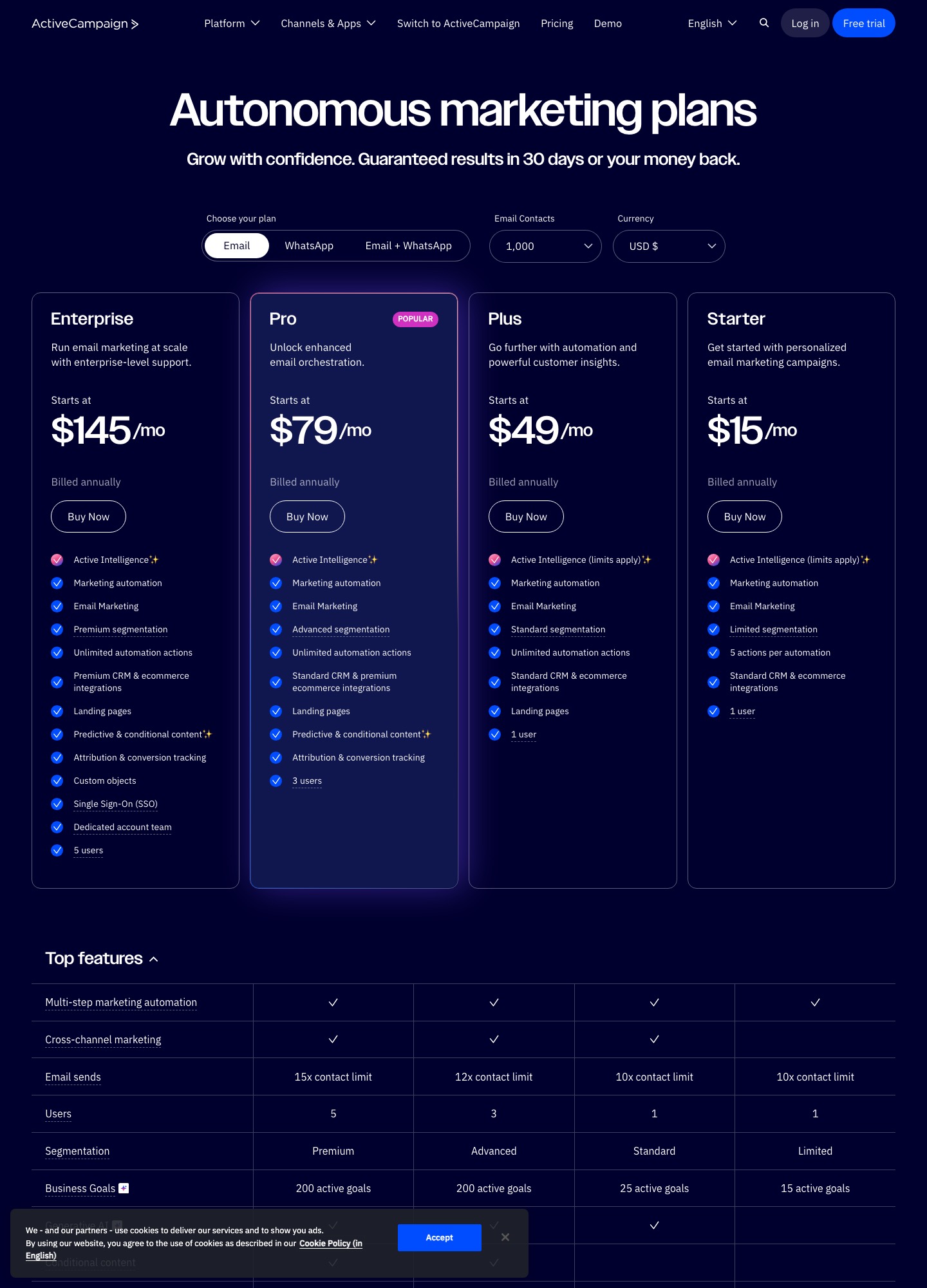
The entry plan is tightly boxed. Starter lists 1 user and 5 actions per automation, and Plus is also limited to 1 user; Pro allows 3 users and Enterprise 5. A welcome series with a wait, a tag, a branch on a click and two more emails runs past five actions quickly. Moving to Pro for the third seat costs $375 at 10,000 contacts, which is $226 more than Starter at the same size.
Everything is billed annually and there is no free plan. Each plan card says "Billed annually", so the $149 a month at 10,000 contacts is a $1,788 yearly commitment. The only way to try the product is the free trial. People who send one monthly newsletter to a few thousand subscribers are paying for a CRM and automation engine they open twice a year.
Add-ons sit outside the price. The pricing page lists transactional email and SMS as add-ons, so a team that wants receipts and password resets from the same account pays on top of the plan.
Quick comparison
| Alternative | Best if you | Billing unit | Price at 5,000 / 10,000 | Free plan |
|---|---|---|---|---|
| MailerLite | want the same job for less | Active subscribers | Comfort $49 / $89; Power $69 / $129 | 250 subscribers, 2,500 emails a month |
| Drip | run store or lifecycle workflows | People on the list plus monthly volume | $89 / $154 | None; 14-day trial |
| Customer.io | trigger on product events | Profiles | Essentials $100 / $145 | None; 12 months free for companies that raised under $10M |
| Kit | publish and sell to an audience | Subscribers | Creator $75 / $116 | Free up to 10,000 subscribers, without sequences |
| Mailchimp | need several seats and wide integrations | Contact bands | Standard $100 / $135 | 250 contacts, 500 sends a month |
| GetResponse | want funnels or webinars | List size | Starter $19 at 1,000; other sizes on its selector | None; free trial |
| Brevo | send in volume, plus transactional mail | Emails per month | Starter from $9, Standard from $18 at 5,000 emails | 300 sends a day |
| HubSpot Marketing Hub | need the CRM to drive the mail | Seats | Starter $7; Professional $800 | Free tools |
ActiveCampaign figures are its Email plan, billed annually. MailerLite, Drip, Customer.io and Mailchimp figures come from each vendor's selector in its monthly view; Kit's are read with yearly billing. Where a vendor does not price by list size, the cell says what the page lists.
Eight alternatives, ordered for people leaving ActiveCampaign
1. MailerLite: the cheaper version of the same job
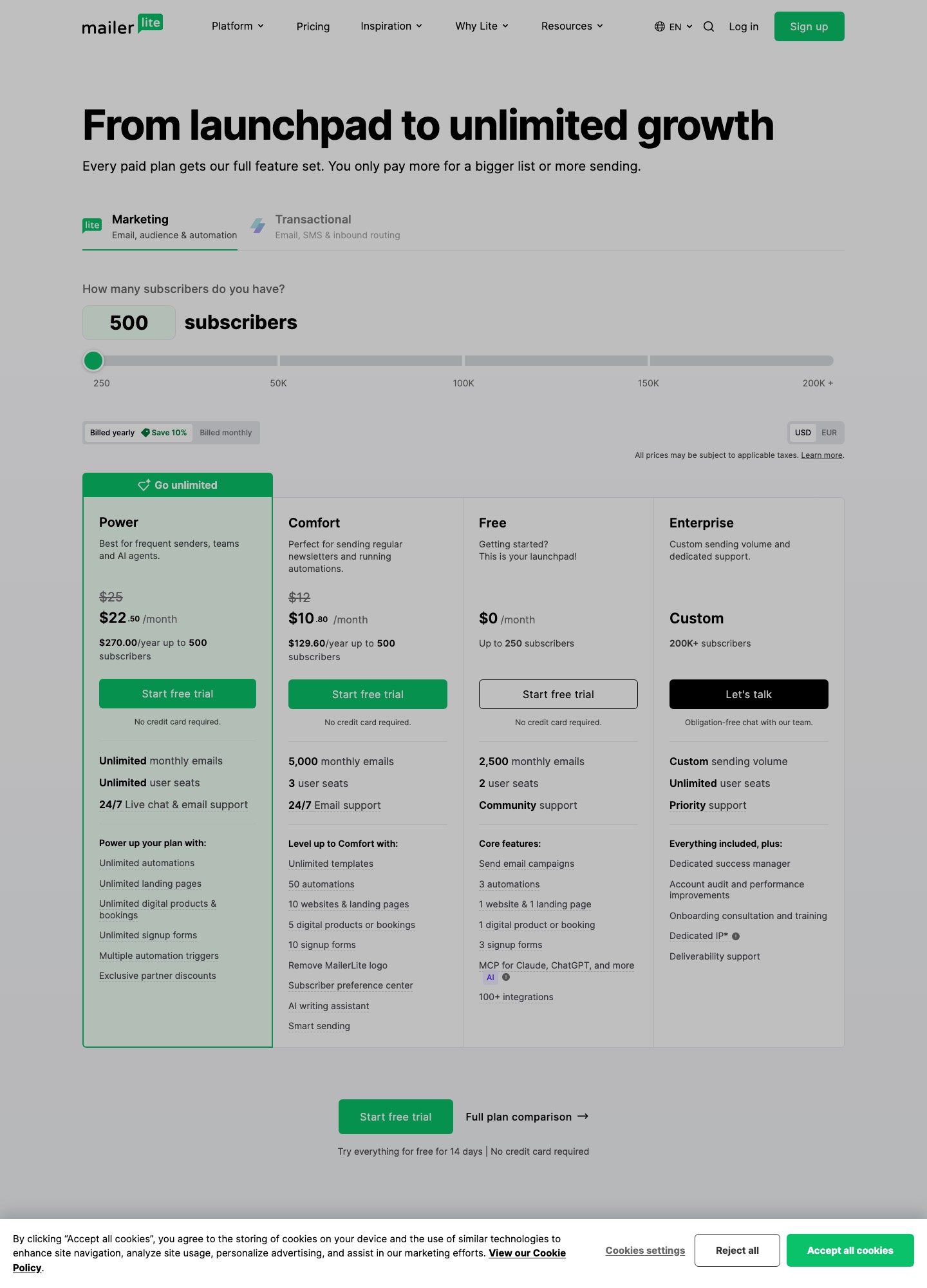
Switch if your ActiveCampaign use is newsletters, forms and a handful of automations, and the contact-based bill is the complaint. MailerLite's pricing page shows Comfort at $19 for 1,000 subscribers, $49 for 5,000, $89 for 10,000 and $179 for 25,000. Power, which has unlimited monthly emails, is $39, $69, $129 and $239 at the same sizes. Against ActiveCampaign Starter the monthly gap is $30 at 5,000, $60 at 10,000 and $212 at 25,000, which is $2,544 over a year. Against Plus, the closer match for segmentation, Power saves $76 at 5,000 and $150 at 25,000.
You gain a free plan with 2 user seats where ActiveCampaign gives you one user on Starter, and Comfort's allowance of 10 times your subscriber tier matches the 10 times contact limit on ActiveCampaign Starter. MailerLite also states that its data storage center is in the European Union with an ISO 27001 certificate, which ActiveCampaign's pricing and DPA pages do not say for their own hosting. You lose ActiveCampaign's CRM view, so check that every integration you use is on MailerLite's list before you commit. Because the MailerLite figures come from the monthly view while ActiveCampaign's are annual rates, the real gap is, if anything, larger. For how MailerLite sits against another big name, see MailerLite vs Mailchimp.
2. Drip: when the workflows are the point
Switch if you sell online and rely on branching automations that ActiveCampaign Starter's five-action cap would cripple. Drip's pricing page has a single plan: $39 up to 2,500 people, $89 at 5,000, $154 at 10,000, $209 at 15,000 and $369 at 25,000, with unlimited email sends and up to 50 workflows. Next to ActiveCampaign Starter the order changes with size: Drip is $10 higher at 5,000, $5 higher at 10,000, then $22 lower at 15,000 and again at 25,000. Next to Plus, which also has more room for segmentation, Drip is $56 cheaper at 5,000 and $20 cheaper at 25,000.
At 50,000 people Drip lists $699 for 600,000 sends and replaces the buy button with a booking form, while ActiveCampaign Plus is $609 at that size, so Drip loses its advantage at the top of the range. Drip has no free plan, only the 14-day trial. Plan on rebuilding every automation by hand in Drip's workflow builder. The two vendors are set against each other in ActiveCampaign vs Drip, and Drip itself against an event-based tool in Customer.io vs Drip.
3. Customer.io: for product events instead of marketing tags
Switch if the thing that starts an email is something your application did, such as a trial expiring or a feature used for the first time, rather than a click on a newsletter. Customer.io's Essentials plan is $100 a month at 5,000 profiles, $145 at 10,000, $235 at 20,000, $325 at 30,000 and $415 at 40,000, billed monthly and including 1 million emails a month. Extra profiles cost $0.009 each, which is $9 per 1,000. ActiveCampaign Starter climbs by $162 between 10,000 and 20,000 contacts, about $16 per 1,000, while Customer.io climbs by $90. At 20,000 that is $235 against $311 for Starter and $329 for Plus.
The trade-offs are real. Essentials does not include managed deliverability, billing counts a profile that existed at any point in the month even if you delete it, and the cheapest step up is Premium at $1,000 a month billed yearly. At 5,000 profiles Customer.io is $21 more than ActiveCampaign Starter, so it only wins when you outgrow the contact-based bill. Companies that have raised under $10M can apply for twelve months free through its Startup Program. This is the pick for SaaS teams, not for retailers.
4. Kit: free until 10,000 if you can live without sequences
Switch if you are a creator, course seller or publisher using ActiveCampaign as an expensive newsletter tool. Kit's free plan covers up to 10,000 subscribers with unlimited broadcasts, forms, landing pages and tagging, while unlimited Visual Automations and sequences start on Creator. Creator costs $75 at 5,000 subscribers, $116 at 10,000 and $166 at 25,000 on its slider. Against ActiveCampaign Starter that is $4 less at 5,000, $33 less at 10,000 and $225 less at 25,000, or $2,700 a year. If you only broadcast, the free plan turns a $149 monthly bill at 10,000 contacts into $0.
Kit Pro adds Subscriber Signals, unlimited users and a newsletter referral system and is $158 at 10,000, where ActiveCampaign Pro is $375 and allows 3 users. Kit also offers free migrations and a 14-day trial. For the neighbouring publisher choice, Buttondown vs Kit compares them directly.
5. Mailchimp: wide integrations and five seats
Switch if several colleagues need logins and your stack was built around plug-ins. Mailchimp's Standard plan lists $100 for 2,501 to 5,000 contacts, $135 for 5,001 to 10,000, $230 for 10,001 to 15,000 and $310 for 20,001 to 25,000, with 5 seats and sends up to 12 times your contacts. Compared with ActiveCampaign Starter's one user and 10 times, that is $21 more at 5,000 contacts, then $14 less at 10,000 and $81 less at 25,000. The Essentials plan starts at $13 but has 3 seats, 10 times sends and custom-coded templates that can be created but not sent.
Read the offer terms: the page shows 50 percent off for the first 12 months, which makes Standard $50 at 2,501 to 5,000 contacts and $67.50 at 5,001 to 10,000, then the full rate applies. Free is 250 contacts and 500 sends a month. Because the gap only opens above 10,000 contacts, this is a seat and ecosystem move first and a savings move second. See MailerLite vs Mailchimp for the cost side.
6. GetResponse: funnels and webinars in the same account
Switch if ActiveCampaign was bought for landing pages and sales sequences and you also want webinars. GetResponse lists Starter at $19 a month ($15.58 on yearly billing) for 1,000 contacts, with unlimited sends, one automation workflow and landing pages. Marketer is $59 ($48.38 yearly) with unlimited workflows, abandoned-cart recovery and sales funnels, and Creator is $69 ($56.58 yearly) with webinars, a website builder and a course creator for up to 500 students.
At 1,000 contacts ActiveCampaign Plus is $49 a month and GetResponse Marketer is $48.38 on yearly billing, so the plans are priced as direct rivals. The case for switching is the bundle, not the price. The page opens at a 1,000-person list, so use the selector to price your own size, and note that its yearly discount saves up to 18 percent. Starter allows only one workflow, which is tighter than ActiveCampaign Starter's five actions per automation.
7. Brevo: priced by emails sent, not by contacts
Switch if you have a large, mostly dormant list and mail it a few times a month. Brevo's pricing page prices by the monthly volume you select. Starter starts at $9 and Standard, which has automation, A/B testing and advanced reports, at $18, both from 5,000 emails a month. On Standard, extra marketing seats are an add-on at $9 a month each, capped at 3 users in total, against one user on ActiveCampaign Starter. A list of 1,000 contacts mailed four times a month sends 4,000 emails and fits the first tier; the same list on ActiveCampaign Plus is $49.
The help article only lists starting prices of $9, $18 and $499 (Professional, for 150,000 to 10 million emails a month), so price your own volume on the slider. Free sends 300 emails a day, so a 2,000-contact list needs seven days to receive one campaign. Brevo also sends transactional email and SMS from the same account, where ActiveCampaign sells both as add-ons. The sending-infrastructure side is covered in Brevo vs SendGrid, and the reasons people later leave Brevo itself are set out in Brevo alternatives.
8. HubSpot Marketing Hub: only if the CRM is the real purchase
Switch if your salespeople work in HubSpot already and email should follow deal stages. HubSpot's Marketing Hub page lists free tools, Starter at $7, Professional at $800 and Enterprise at $3,600 a month, and says pricing is per seat. Email automation is 1 action on the free tier, up to 10 actions on Starter, and unlimited actions only from Professional. Starter's 10-action ceiling is double ActiveCampaign Starter's 5, but anything bigger means the $800 plan, which is $611 above ActiveCampaign Plus at 10,000 contacts.
That price gap is why this is the narrowest recommendation on the list. It works for a company that would otherwise run a CRM beside ActiveCampaign, and it does not work for a newsletter. HubSpot's own page publishes no contact-based prices that we can compare at 5,000 or 10,000 contacts, so treat any quote you receive as the real number.
What ActiveCampaign itself costs
ActiveCampaign's Email plans start at $15 (Starter), $49 (Plus), $79 (Pro) and $145 (Enterprise) a month at 1,000 contacts, billed annually; 10,000 contacts reads $149, $189, $375 and $589. Sends are capped at 10 times contacts on Starter and Plus, 12 times on Pro and 15 times on Enterprise. The capture below shows only the default 1,000-contact readout ($15, $49, $79 and $145); the larger sizes quoted on this page come from the contact selector on the live page.
Switching from ActiveCampaign
What exports. Plan on the contact records being the part that moves: before you cancel, export them from ActiveCampaign and check that the fields, tags and sign-up dates you segment on are in the file. Kit lists free migrations on its pricing page, which is worth asking about if you pick it.
What to rebuild. Assume the automations are rebuilt by hand in the new tool: the branching, goals and waits. If you are on Starter, the 5-action limit means yours are probably short, which makes the job quicker. Lead scores, deals, site-tracking history and conditional content are features ActiveCampaign lists, so check whether the new tool has an equivalent before you rely on it. Save past campaign reports and the templates you still use before the account closes.
Consent and suppression. Export unsubscribed, bounced and complained addresses separately and import them as suppressed in the new tool before the first send. A person who unsubscribed in ActiveCampaign must not receive the first campaign from the new system just because the import file only held active contacts. Keep the column that records when and how each person opted in, because the new tool may not collect it for you.
The pilot. Do not close the old account on day one. Move one list, rebuild the single automation that earns money, send to a small seed of your own addresses, then run both tools for a month. Cancel when the new one has sent a full cycle without a bounce spike. Our guide to choosing an email tool has a decision checklist for the pilot, and the bulk sending guide covers warming a new sender.
Yearly cost for the shortlist
| Plan | 5,000 contacts | 10,000 contacts | 25,000 contacts | Per year at 10,000 |
|---|---|---|---|---|
| ActiveCampaign Starter | $79 | $149 | $391 | $1,788 |
| ActiveCampaign Plus | $145 | $189 | $389 | $2,268 |
| MailerLite Comfort | $49 | $89 | $179 | $1,068 |
| MailerLite Power | $69 | $129 | $239 | $1,548 |
| Kit Creator | $75 | $116 | $166 | $1,392 |
| Mailchimp Standard | $100 | $135 | $310 | $1,620 |
| Customer.io Essentials | $100 | $145 | Not listed (20,000 is $235; 30,000 is $325) | $1,740 |
| Drip | $89 | $154 | $369 | $1,848 |
The last column is twelve times the 10,000-contact monthly figure (for example $89 x 12 = $1,068). Nothing here includes taxes, add-ons or overages. For other tools in this category, browse all alternatives pages, the tools directory, or the beehiiv alternatives if you publish a newsletter.
Choose by situation
- Pick MailerLite when the list is between 5,000 and 25,000 and you want the largest drop in the monthly bill.
- Pick Drip when you run a store and need dozens of workflows rather than five actions.
- Pick Customer.io when the starting event is something your application did.
- Pick Kit when you broadcast to an audience of up to 10,000 and can leave sequences for later.
- Pick Mailchimp when you need five seats and a long integration list and accept a contact-band bill.
- Stay on ActiveCampaign when the CRM, deals and conditional content are in daily use and your list is under about 5,000 contacts.
FAQ
Is there a free ActiveCampaign alternative?
ActiveCampaign has no free plan, only a free trial. Kit is free up to 10,000 subscribers with unlimited broadcasts but without sequences, MailerLite gives 250 subscribers and 2,500 emails a month, Mailchimp gives 250 contacts and 500 sends, and Brevo allows 300 sends a day.
Which alternative is cheapest at 10,000 contacts?
Among the priced plans above, MailerLite Comfort is the lowest at $89 a month, ahead of Kit Creator at $116 and Mailchimp Standard at $135. Kit's free plan costs nothing at that size, but sequences and automations need Creator. ActiveCampaign Starter reads $149 for the same list.
Will my ActiveCampaign automations transfer?
Plan on rebuilding every automation by hand in the new tool, and export your contacts before you cancel. Starter allows 5 actions per automation, so many accounts have short flows that rebuild quickly.
Is ActiveCampaign Starter enough for a small business?
It suits a single user with a short welcome flow: $15 for 1,000 contacts, 1 user and 5 actions per automation. It stops fitting when you need a second login, longer branches or a list above 25,000, where Starter is no longer offered.