Kit (ConvertKit) alternatives for broadcast email: what to use once Creator gets expensive
Kit, formerly ConvertKit, is free to 10,000 subscribers; Creator is $75 at 5,000 and $116 at 10,000. Eight alternatives priced at 1,000 to 25,000.
Short answer
If you only send broadcasts, do not leave Kit: its free plan covers up to 10,000 subscribers and no alternative below lists a free subscriber limit that high. The people who do leave are paying for Creator to get sequences and automations, and for them MailerLite is the best replacement, with Comfort at $49 a month at 5,000 subscribers against Kit's $75, and Power at $129 at 10,000 against $116 for Creator but with unlimited emails. Creators who sell products should price Systeme.io, which lists a free plan for 2,000 contacts and 0% transaction fees. Kit is the product formerly called ConvertKit, and its pricing page is kit.com/pricing. Prices were read on 7 October 2026 in US dollars.
Why people leave Kit
The free plan is generous and the cliff is where automation begins. Kit's pricing page lists Free for up to 10,000 subscribers with unlimited landing pages, forms and broadcasts plus tagging and segmentation, but Visual Automations and sequences start on Creator. Creator is quoted at $33 a month at 1,000 subscribers ($390 billed yearly, which the page says saves $78 a year), $75 at 5,000, $116 at 10,000 and $166 at 25,000. A writer who has 10,000 subscribers and needs one welcome sequence goes from $0 to $1,392 a year, and that single decision is the most common reason this page gets read.
The second step is Pro. At 10,000 subscribers it reads $158 against Creator's $116, a $42 monthly premium, and at 25,000 it reads $233 against $166, a $67 premium. Pro is where unlimited users, Subscriber Signals, deliverability reporting and the newsletter referral system sit, so a one-person publication may be paying for a plan whose headline features it does not use. The listed Pro price at 1,000 subscribers is $66, with a first-year promotion that shows $50, so the promotional year is not the price that renews.
Third, the page quotes prices for specific list sizes and billing toggles, so rows are not always comparable. The $33 at 1,000 is the yearly-billed rate. We did not record the toggle state for the larger stops, which means every difference against another tool below is only like-for-like if both sides use the same billing period. Finally, removing Kit branding is listed from Creator upward, so a free-plan sender should look at how that appears to readers.
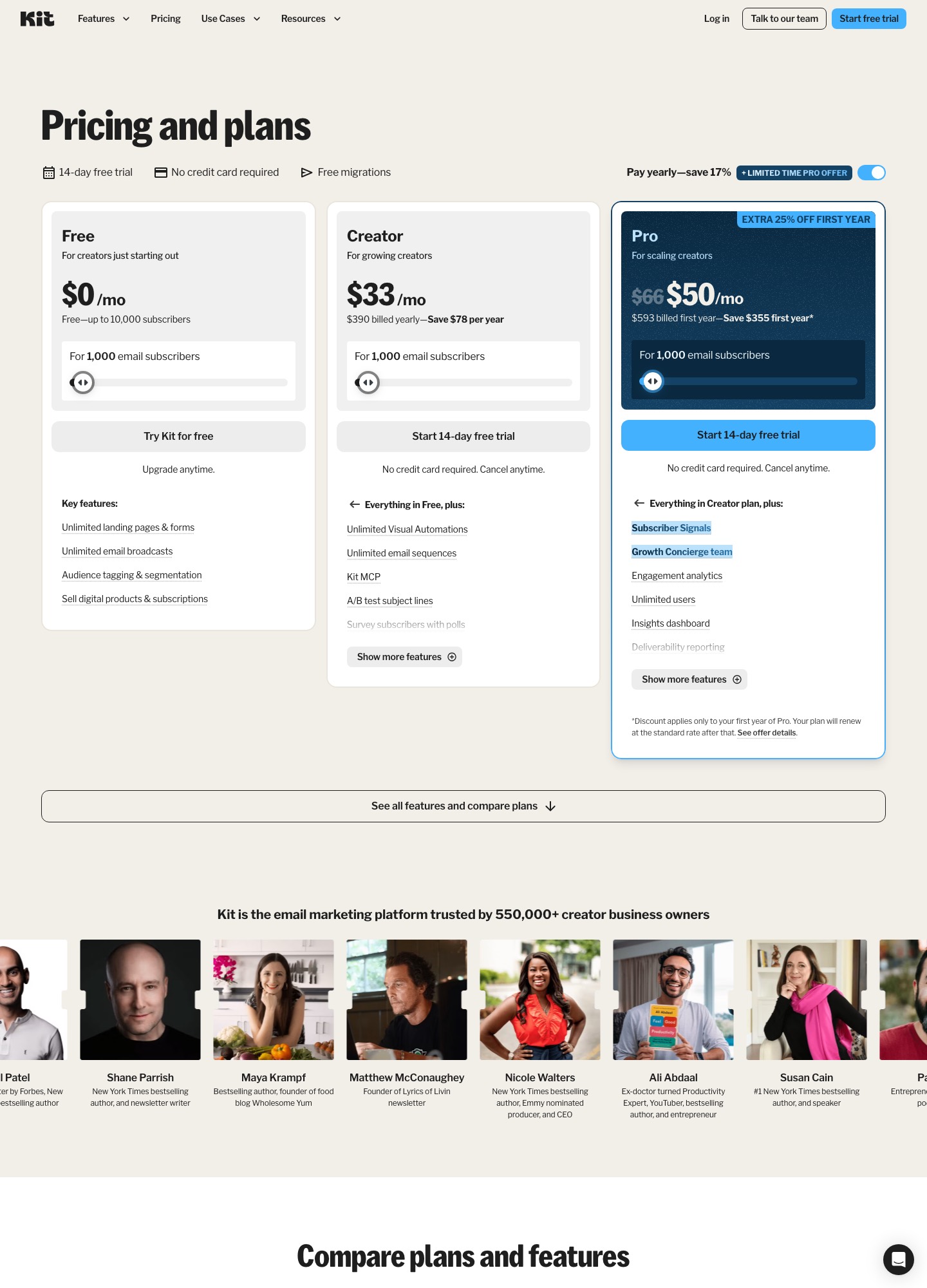
Reasons to stay: Kit's page lists 24/7 email and chat support on Creator, a 14-day trial with no card, free migrations, SMS marketing on Creator and the ability to sell digital products and subscriptions on the Free plan. If your list is under 10,000 and your automations are simple, the cost of moving is higher than the cost of staying.
Quick comparison
| Alternative | Best if you | Billing unit | Price at two list sizes | Free plan |
|---|---|---|---|---|
| MailerLite | want automations at a lower per-subscriber price | Subscribers | Comfort $49 / $89 and Power $69 / $129 at 5,000 / 10,000 | 250 subscribers, 2,500 emails a month |
| Systeme.io | sell courses and products without transaction fees | Contact tier | Startup $17 to 5,000; Webinar $47 to 10,000 | 2,000 contacts, 1 email campaign |
| beehiiv | want a publication with a web presence | Subscribers (slider) | Lite $95 / $119 yearly at 5,000 / 10,000 | 2,500 subscribers, 1 publication |
| Flodesk | want design-led emails and checkout | Active subscribers | Lite $52 / $72 monthly at 5,000 / 10,000 | Forms and pages only, no sending |
| Ghost | want to own the website and paid members | Members | Publisher $29 at 1,000; Business $199 up to 10,000 | None on managed plans |
| Substack | want no monthly fee and accept a cut | Share of paid revenue | 10% of subscription revenue plus card fees | Free to publish |
| EmailOctopus | send simple broadcasts to a big list cheaply | Subscribers | Pro $9 yearly at the 10,000 stop | 2,500 subscribers, 10,000 emails a month |
| Kajabi | run a course business first and a newsletter second | Products and contacts | Basic $143 annual / $179 monthly; Growth $199 / $249 | None |
The eight alternatives
1. MailerLite: the plan-for-plan replacement
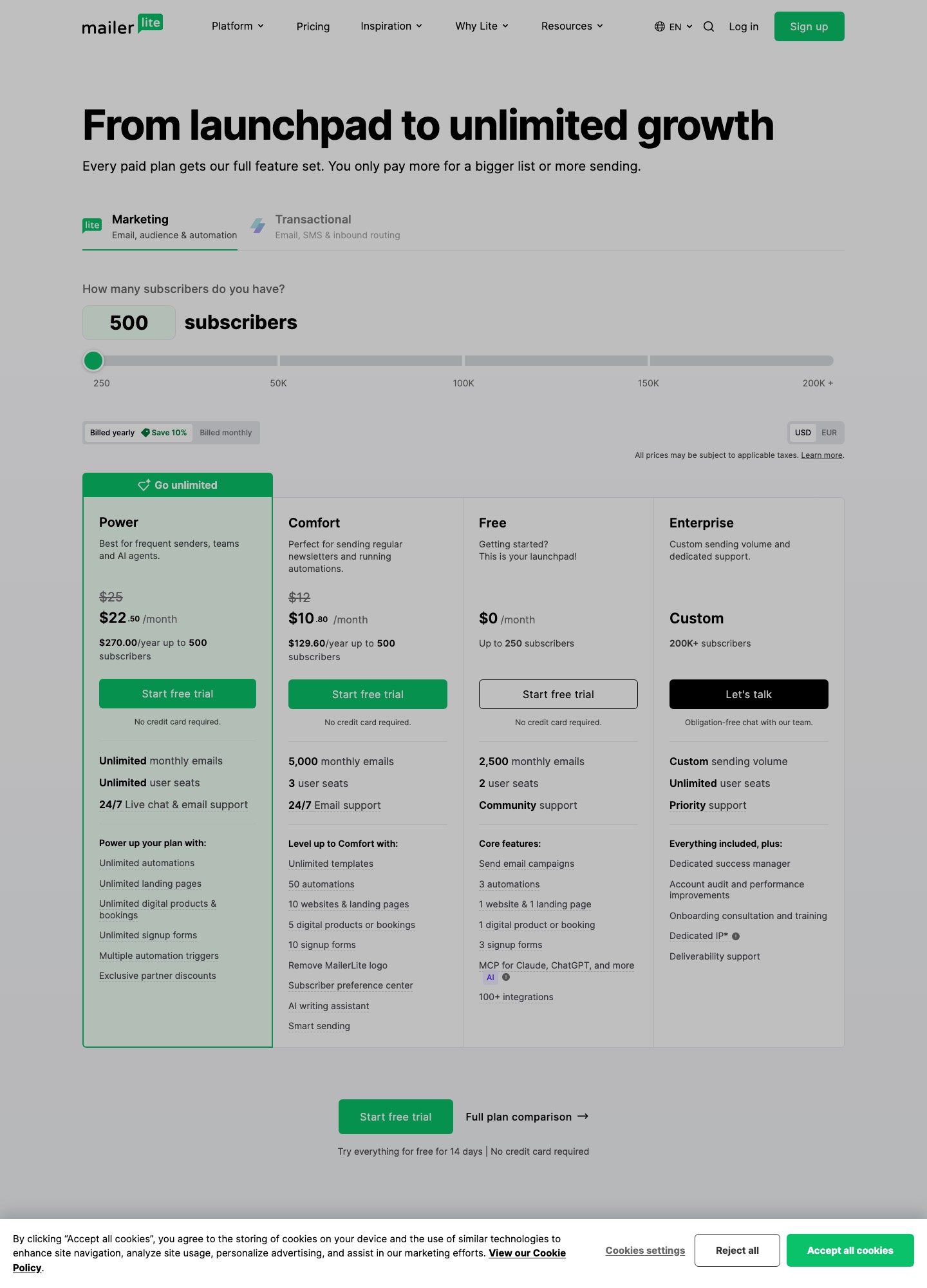
MailerLite is for the Kit customer whose bill is mostly Creator's automation and sequences. Its pricing page lists Comfort at $19 a month at 1,000 subscribers, $49 at 5,000 subscribers, $89 at 10,000 subscribers and $179 at 25,000 subscribers, and Power at $39, $69, $129 and $239 on the same four stops. The monthly gap to Creator is $26 at 5,000 subscribers and $27 at 10,000 subscribers. At 25,000 subscribers the order flips, with Comfort at $179 above Creator's $166. Power gives unlimited monthly emails; Comfort allows 10 times the subscriber-tier ceiling.
What you give up is Kit's free ceiling: MailerLite's Free plan stops at 250 subscribers, 2,500 emails a month and 2 seats, so a list between 250 and 10,000 pays from the start. Its page also states EU data storage with ISO 27001. Digital product sales are listed among MailerLite's features, but we did not read their fees, so price the checkout side before moving a store. Migration is a CSV import plus rebuilding each sequence by hand. For the comparison with the other volume leader, see MailerLite vs Mailchimp.
2. Systeme.io: when the product is the business
Systeme.io fits the creator who uses Kit mainly as the email engine behind a few digital products. Its pricing page lists a Free plan that never expires, with 2,000 contacts, 3 funnels, 1 automation rule, 1 custom domain, 1 email campaign, 1 course and 500 students. Startup is $17 a month for 5,000 contacts, 10 funnels, 10 automation rules and 5 courses; Webinar is $47 for 10,000 contacts; Unlimited is $97 with unlimited contacts. It states unlimited emailing on every plan and 0% transaction fees, with payments by Stripe or PayPal at no extra charge.
Set those numbers beside Kit Creator, which is $75 at 5,000 subscribers and $116 at 10,000 subscribers. The monthly gap is $58 at the first size and $69 at the second. The caveat sits in the limits. Startup lists 10 email campaigns and 5 workflows, and Free lists 1 of each, so count your sends and sequences against those numbers before assuming it replaces unlimited Visual Automations. The page's FAQ also mentions unlimited funnels on Startup where the comparison table says 10, so use the table's numbers.
3. beehiiv: a publication, not just a sending tool
beehiiv suits the Kit user who now publishes a newsletter on the web and wants growth tools built in. Its Free plan covers 2,500 subscribers with unlimited sends, one publication and one team seat. Lite starts at $49 a month on yearly billing with paid subscriptions, automations and polls, and reads $95 yearly or $109 monthly at 5,000 subscribers and $119 yearly or $139 monthly at 10,000. Pro reads $169 yearly at 5,000 and $199 yearly at 10,000, with 10 team seats. For comparison, Kit Pro at 10,000 subscribers reads $158. beehiiv Lite is $119 yearly and beehiiv Pro is $199 yearly at that size. Set against the $158 above, the Lite figure is $39 lower and the Pro figure is $41 higher, and the Lite figure is also $3 above the $116 quoted for Creator.
The reason to pay that is revenue handling: beehiiv states that it takes 0% of paid subscription and digital product revenue, leaving Stripe's 2.9% + $0.30 per transaction. We did not read an equivalent statement for Kit. Consider it if you were about to buy Pro for referrals and want that bundled with a web archive. The paid-newsletter angle is covered in beehiiv vs Substack.
4. Flodesk: design first, workflows gated by plan
Flodesk is for a creator whose emails are part of a brand. Flodesk's pricing page prices by active subscribers: Lite is $25 a month at up to 1,000 subscribers ($19 annual), $32 at 2,500 subscribers, $52 at 5,000 subscribers, $72 at 10,000 subscribers and $162 at 25,000 subscribers. The monthly saving against Creator is $8 at 1,000 subscribers, $23 at 5,000, $44 at 10,000 and $4 at 25,000. The catch is Lite's single workflow. Pro at $28 ($25 annual) at 1,000 subscribers adds unlimited workflows, advanced analytics and integrated checkout with 2 seats, and Everything at $54 ($49 annual) lists unlimited checkouts, sales pages, payment plans and subscriptions with 3 seats.
So the like-for-like replacement for a Kit user with several sequences is Flodesk Pro, which the pricing page lists at $28 monthly ($25 annual) at 1,000 subscribers, $39 monthly ($35 annual) at 2,500 subscribers, $59 ($54 annual) at 5,000 subscribers, $79 ($72 annual) at 10,000 subscribers and $169 ($155 annual) at 25,000 subscribers. Against Creator's quoted prices the saving is $5 a month at 1,000 subscribers, $16 at 5,000 and $37 at 10,000, but at 25,000 subscribers Pro costs $3 more. Billing periods may differ between the two sides, as noted above. Flodesk's free plan is forms, landing pages and link-in-bio pages with no sending. Choose it when the visual side dominates your brand and your sequence count is small.
5. Ghost: own the site, the members and the checkout
Ghost is for a creator who wants the website, the newsletter and paid memberships in one product. Ghost's pricing page lists Starter at $15 a month for up to 1,000 members with one staff user and no paid subscriptions, Publisher at $29 with three staff users, custom themes, paid subscriptions and analytics, and Business at $199 for up to 10,000 members and 15 staff users, all billed yearly. Creator is $33 at 1,000 subscribers, so Publisher saves $4 a month. At 10,000 the Business plan sits $83 above Creator and $41 above Pro.
What Ghost gives is ownership of the theme and the domain; what it takes is the free plan, since its managed plans carry no free tier (the software is open source if you host it yourself). We did not read Ghost's automation features on its pricing page, so a Kit customer with a welcome sequence or an automation tied to purchases should test that before paying. Compare it with its closest rival on Ghost vs Substack.
6. Substack: zero fixed cost, 10% of revenue
Substack is for the writer with a paid audience and no wish to manage a bill. Substack keeps 10% of subscription revenue, and its page quotes Stripe's 2.9% + $0.30 per US card payment plus 0.7% for Stripe Billing; publishing for free is allowed. A custom domain costs a one-time $50, emails still come from a substack.com address, and the subscriber export has no names. Starting on 1 December 2026 Substack says it will collect and remit sales tax or VAT on paid subscriptions at no extra charge, with exceptions for Brazil, Mexico, Malaysia, India and Thailand.
The arithmetic against Kit: $116 a month at 10,000 subscribers is $1,392 a year, and a 10% share equals that when paid subscription revenue reaches $13,920 a year. Below that revenue Substack's 10% share is smaller than Creator's fee, and above it the share is larger. Card processing fees come on top of that on both sides, so treat the break-even as a rough guide to the platform fee alone. Free subscribers cost nothing there, so a large free list with few payers is the sweet spot. Expect to lose the custom sender address, because emails keep coming from a substack.com address even with a custom domain.
7. EmailOctopus: a very low price for plain broadcasts
EmailOctopus is the pick for a leaver who bought Creator only for volume and does not use the automations. Its pricing page lists Free at 2,500 subscribers and 10,000 emails a month with EmailOctopus branding, reports kept for 30 days, one landing page and form and one user. Pro reads $9 a month, billed yearly, at the 10,000 setting, with reports kept forever and unlimited landing pages, forms and users. Next to Creator's $116 at 10,000, that is $107 less, $1,284 a year.
Read the allowance before trusting the price, because the stop we read shows 10,000 emails a month, and four sends a month to 10,000 subscribers is 40,000 emails. We did not read the cost of a higher email allowance, so treat the $9 as a floor, not a quote for a weekly newsletter. Compared with Kit's free plan, EmailOctopus gives you 2,500 subscribers where Kit gives 10,000, so it only helps once you are past that.
8. Kajabi: only if courses are the main business
Kajabi is not a cheaper email tool; it is where a creator goes when the course platform should be the center. Its pricing page read Basic at $143 a month billed annually ($179 monthly) for 5 products and 2,500 contacts, Growth at $199 annually ($249 monthly) for 50 products and 25,000 contacts, and Pro at $399 annually ($499 monthly) for unlimited products and 100,000 contacts. There is no free plan, and the ladder is built from products, so the email list does not set the price the way it does at Kit.
That structure can work in your favor at a large list: Kajabi's Growth at $199 allows 25,000 contacts, where Kit Creator at 25,000 subscribers is $166 and Pro is $233. It only wins if you would otherwise be paying for a course host as well. For most Kit leavers it is a bigger purchase than the problem calls for.
Cost at four list sizes
| Tool and plan | 1,000 | 5,000 | 10,000 | 25,000 |
|---|---|---|---|---|
| Kit Free (broadcasts, tags) | $0 | $0 | $0 | Above the free limit |
| Kit Creator | $33 | $75 | $116 | $166 |
| Kit Pro | $66 ($50 first-year promotion) | Not read | $158 | $233 |
| MailerLite Comfort (monthly) | $19 | $49 | $89 | $179 |
| MailerLite Power (monthly) | $39 | $69 | $129 | $239 |
| Flodesk Pro (monthly) | $28 | $59 | $79 | $169 |
| Flodesk Lite (monthly) | $25 | $52 | $72 | $162 |
| beehiiv Lite (yearly billing) | Free to 2,500 | $95 | $119 | Not read |
| Systeme.io (plan that covers the list) | Free to 2,000, then $17 | $17 Startup | $47 Webinar | $97 Unlimited |
| Ghost (yearly billing) | $15 Starter, $29 Publisher | Not read | $199 Business | Not read |
Kit's Creator figures are quoted per list size on its pricing page; the 1,000 figure is billed yearly and the larger stops were not recorded with their billing toggle. Substack, EmailOctopus and Kajabi are left out because they do not price on this ladder. Systeme.io's $17, $47 and $97 are the plan prices for the 5,000, 10,000 and unlimited contact ceilings; the 25,000 cell assumes the Unlimited plan.
Switching from Kit
Kit subscribers export as a list, but your structure lives in tags, forms and sequences, and none of those are portable files. Before you cancel, write down every tag with its meaning, every form and where it is embedded, and every sequence with its delay logic. Tags usually become a custom field or tag in the new tool; forms need replacing on your site; sequences must be rebuilt step by step. Also keep a copy of each subscriber's signup date and source, because that is your consent record.
Handle unsubscribes and bounces as data, too. Import the suppression list as suppressed so a person who left in March is not re-added by the migration. If you sold products through Kit, check how existing purchasers and subscriptions are handled, because a customer's access lives with the seller's payment setup, not in a mailing list. Customer emails that Kit sends after purchase will stop on the day you disable the automation, so move the delivery email first.
Pilot with the sequence you rely on most. Rebuild only the welcome sequence in the new tool, switch the signup form to it for a week, and compare how many new subscribers receive email one against the form's submissions. When that count matches, repeat with the next sequence and finally copy the old list, using free migrations from the destination where offered. Good habits for those first weeks are in the newsletter best practices post, and building a newsletter audience explains why your signup sources deserve their own records. The newsletter tools page, the alternatives hub and Buttondown vs Kit cover neighbouring choices.
FAQ
Is ConvertKit the same as Kit?
Yes. Kit is the product formerly called ConvertKit, and its pricing page is kit.com/pricing. This guide's URL keeps the old name so that existing links to it keep working.
Is Kit free?
Its Free plan covers up to 10,000 subscribers with unlimited landing pages, forms and email broadcasts and tagging and segmentation. Visual Automations and sequences start on Creator, quoted at $33 a month for 1,000 subscribers, $75 for 5,000 and $116 for 10,000.
What is the cheapest alternative to Kit Creator at 10,000 subscribers?
Of the options with a published price at that size, EmailOctopus Pro at $9 billed yearly is lowest but read its email allowance first, Systeme.io Webinar at $47 is next, then Flodesk Lite at $72, MailerLite Comfort at $89 and beehiiv Lite at $119 on yearly billing.
Which alternative is best for selling digital products?
Systeme.io states 0% transaction fees, with payments by Stripe or PayPal, and beehiiv states a 0% take on paid subscription and digital product revenue beyond Stripe's fees. Flodesk Pro adds integrated checkout. Substack takes 10% of subscription revenue.